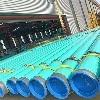
Buttress Thread Casing Couplings in API 5CT
A buttress thread casing coupling, commonly abbreviated BTC, is a heavy-wall internally threaded sleeve used to connect casing joints in a well. The buttress thread has a load flank close to square and a steeper stab flank, so the thread carries axial tension on a broad contact face instead of on the flanks of a triangular thread. That geometry allows one of the highest joint efficiencies of any API connection and is why buttress couplings are chosen for deep, heavy strings.
The 20 inch, 133 lb/ft size is a large diameter, heavy wall casing used as conductor, surface and intermediate pipe. In this size the coupling runs to API 5CT and the thread dimensions follow the API 5B gauging practice, so the coupling body is machined with the correct taper, pitch and thread height, and each lot is verified with plug and ring gauges.
Specification of the 20 Inch BTC Casing Coupling
| Item | Value |
|---|---|
| Product | Buttress thread casing coupling |
| Standard | API 5CT, threads per API 5B |
| Material grades | K55, N80 and L80 |
| Nominal size | 20 inch (508.0 mm) |
| Nominal weight | 133 lb/ft (197.9 kg/m) |
| Thread type | Buttress casing thread, 5 threads per inch |
| Surface treatment | Painted body for transport, threads protected by compound and steel caps |
| Inspection | Composition, hardness, thread gauging, dimensional check |
Grade Comparison for K55, N80 and L80
| Grade | Yield strength | Tensile strength, minimum | Heat treatment | Comments |
|---|---|---|---|---|
| K55 | 379 to 552 MPa (55,000 to 80,000 psi) | 655 MPa (95,000 psi) | As-rolled or normalised | Economical grade for surface and intermediate casing |
| N80 | 552 to 758 MPa (80,000 to 110,000 psi) | 689 MPa (100,000 psi) | Quenched and tempered or normalised and tempered | Higher collapse and internal yield for deeper strings |
| L80 | 552 to 655 MPa (80,000 to 95,000 psi) | 655 MPa (95,000 psi) | Quenched and tempered | Controlled hardness for sour service environments |
The three grades share the same coupling dimensions for a given casing size, so a string can be upgraded from K55 to N80 or L80 without changing handling tools, torque tables or running procedures. L80 is specified when the well fluid contains hydrogen sulphide, because its controlled yield range and maximum hardness reduce the risk of sulphide stress cracking.
Why Choose a Buttress Thread Connection
Axial tension is carried on the near-square load flank, giving a high joint strength in heavy strings.
Readily stabbed in the field because of the steep stab flank and deep thread form.
Withstands repeated make-up and breakout cycles during workover operations.
Available in all common casing sizes and weights, including 20 inch and above.
Handling, Make-Up and Inspection Points
Large diameter casing couplings are heavy and easily damaged in transport. Lifting slings are placed under the coupling body, not through the bore, and couplings are stacked on timber so that the machined threads never touch the ground. Before make-up, the thread and sealing surfaces are cleaned with a soft brush, dried and coated with a compound approved for the well temperature.
Make up to the torque listed for the casing size, weight and grade, using a calibrated power tong and a backup tong on the pipe body.
Record the turns and torque for every joint so that a suspected tight or cross-threaded joint can be traced later.
Inspect threads for galling, tearing and dents after each breakout; a damaged coupling is replaced rather than re-cut in the field.
Confirm the drift diameter of the coupling after make-up to ensure wireline tools will pass.
FAQ
Q: What is the difference between BTC and STC connections?
BTC uses a buttress thread that carries load on a broad, near-square flank for high tensile capacity. STC uses a rounded triangular thread with a shorter thread length and is intended for lighter service.
Q: Is a 20 inch 133 lb/ft coupling available in all three grades?
Yes. K55, N80 and L80 are all produced to API 5CT in this size, with the same coupling dimensions so that grades can be interchanged in the string design.
Q: Why is L80 preferred for sour wells?
L80 has a restricted yield range and hardness limit, which reduces susceptibility to sulphide stress cracking in wells where hydrogen sulphide is present.
Q: How many make-up and breakout cycles can a buttress coupling withstand?
API 5B gauging practice governs the limit. As a working rule the coupling is re-gauged after each breakout, and a coupling that fails the gauge or shows thread damage is removed from service.
Q: What thread compound should be used?
A compound compatible with the service temperature and with the buttress thread form is required. Copper based or graphite based compounds are selected according to the well conditions and the operator specification.
Q: How is the coupling protected during shipping?
Threads are coated with compound and closed with steel or plastic protectors, and the outer surface is painted. Protectors stay in place until the joint is ready to be made up on site.