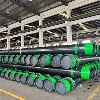
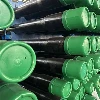
In API Buttress Connection Data sheet shows that the casing is externally threaded on both ends of non-upset pipe. The single lengths are joined by an internally threaded coupling. - The thread profile has flat crests and roots parallel to the taper cone with angles 3° and 10° to the vertical of the pipe axis; and 5 threads per inch on a 0,0625 inch per inch taper for sizes 13% inch and smaller, and 0,0833 inch per inch for sizes 16 inch and larger.
Thread Forms and Taper: 5 TPI Buttress Thread vs 8 TPI Round
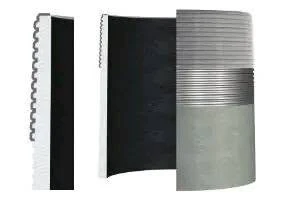
Four API connection families share the same standard but not the same thread form or pitch.
Table 1 - Thread forms, TPI and taper by connection family (API 5B, 16th edition)
| Form | TPI | Pitch (in) | Taper | Source |
|---|---|---|---|---|
| Casing round 8 tpi (STC / LTC) | 8 | 0.125 | 3/4 in/ft (0.0625 in/in) | Table 11 |
| Line pipe thread | 27 to 8 by size | - | 3/4 in/ft | Table 13 |
| Tubing round 10 tpi (NU / EU) | 10 | 0.100 | 3/4 in/ft | Table 15 |
| Buttress casing (BTC / BCSG) | 5 | 0.200 | 3/4 in/ft to 13-3/8 in; 1 in/ft at 16 in and larger | Table 5 |
5 TPI buttress thread is 5.080 mm pitch. The API 5B buttress casing taper changes at 16 in; one taper cannot be quoted across the full size range.
Side-by-Side Thread Comparison: API Buttress Connection vs STC, LTC and EUE
The comparison below is the same one a buyer uses to decide which connection the string needs.
Table 2 - Thread family comparison (RigPal thread chart)
| Feature | NPT | STC | LTC | BTC | EUE |
|---|---|---|---|---|---|
| Thread form | V 60 deg | V 60 deg | V 60 deg | Square / trapezoidal | V 60 deg |
| TPI | 8 - 27 | 8 | 8 | 5 | 8 - 10 |
| Taper | 3/4 in/ft | 3/4 in/ft | 3/4 in/ft | Pin tapered, box straight | 3/4 in/ft |
| Seal type | Thread interference | Thread interference | Thread interference | Stab flank bearing | Thread interference |
| Pressure rating | Low - medium | Medium | Medium - high | High | Medium - high |
| Primary use | Industrial piping | Surface casing | Production casing | Deep casing | Production tubing |
| Make-up | Wrench tight | Power tongs | Power tongs | Power tongs | Power tongs |
| Standard | ANSI B1.20.1 | API 5B | API 5B | API 5B | API 5B |
BTC is not gas-tight. Where a gas-tight seal is specified, an API connection is not the document that supplies it.
Casing - Buttress Thread (BTC): API 5B Table 5
The table is the API 5B buttress thread dimensional record. Dimensions are inches.
Table 3 - API 5B Table 5 - buttress casing thread dimensions, all 14 sizes
| Size (in) | D4 major (in) | TPI | g (in) | L7 (in) | L4 (in) | E7 (in) | M (in) | Lc min (in) |
|---|---|---|---|---|---|---|---|---|
| 4-1/2 | 4.5165 | 5 | 1.984 | 1.6535 | 3.6375 | 4.454 | 1.884 | 1.2535 |
| 5 | 5.0165 | 5 | 1.984 | 1.7785 | 3.7625 | 4.954 | 1.784 | 1.3785 |
| 5-1/2 | 5.5165 | 5 | 1.984 | 1.8410 | 3.8250 | 5.454 | 1.784 | 1.4410 |
| 6-5/8 | 6.6415 | 5 | 1.984 | 2.0285 | 4.0125 | 6.579 | 1.784 | 1.6285 |
| 7 | 7.0165 | 5 | 1.984 | 2.2160 | 4.2000 | 6.954 | 1.784 | 1.8160 |
| 7-5/8 | 7.6415 | 5 | 1.984 | 2.4035 | 4.3875 | 7.579 | 1.784 | 2.0035 |
| 8-5/8 | 8.6415 | 5 | 1.984 | 2.5285 | 4.5125 | 8.579 | 1.784 | 2.1285 |
| 9-5/8 | 9.6415 | 5 | 1.984 | 2.5285 | 4.5125 | 9.579 | 1.784 | 2.1285 |
| 10-3/4 | 10.7665 | 5 | 1.984 | 2.5285 | 4.5125 | 10.704 | 1.784 | 2.1285 |
| 11-3/4 | 11.7665 | 5 | 1.984 | 2.5285 | 4.5125 | 11.704 | 1.784 | 2.1285 |
| 13-3/8 | 13.3915 | 5 | 1.984 | 2.5285 | 4.5125 | 13.329 | 1.784 | 2.1285 |
| 16 | 16.0000 | 5 | 1.488 | 3.1245 | 4.6125 | 15.938 | 1.313 | 2.7245 |
| 18-5/8 | 18.6250 | 5 | 1.488 | 3.1245 | 4.6125 | 18.563 | 1.313 | 2.7245 |
| 20 | 20.0000 | 5 | 1.488 | 3.1245 | 4.6125 | 19.938 | 1.313 | 2.7245 |
These BTC thread dimensions are the API 5B record; D4 is the major thread diameter. It exceeds nominal pipe OD by 0.0165 in up to 13-3/8 in, and equals nominal OD at 16 in and larger. L4 is the total thread length consumed by the API 5C3 joint-strength formula.
Column Key
Table 4 - What each symbol on the data sheet measures
| Symbol | Definition |
|---|---|
| L1 | Length, pipe end to hand-tight plane |
| L2 | Length of effective (full-form) thread |
| L4 | Total length, pipe end to vanish point (total thread length) |
| L7 | Length of complete (perfect) thread - buttress |
| E7 | Pitch diameter at plane E7 - buttress |
| M | Length, coupling face relationship at makeup |
| Lc min | Minimum length of full-crest thread from pipe end |
| g | Length allowance for imperfect threads at the vanish point - buttress |
| D4 | Major (large-end) thread diameter |
On a buttress connection L7 replaces L2 and g is the imperfect-thread allowance; Lc = L7 - 0.400 in across all 14 sizes.
Two things most sources get wrong: buttress connection taper
The taper is not one value for every size, and the buttress figures are not round-thread figures.
Table 5 - Buttress casing pitch diameter and standoff tolerance (API 5B BCSG gauge tables)
| Size (in) | TPI | Taper per foot | Pitch diameter (mm) | Standoff tolerance (mm) |
|---|---|---|---|---|
| 4-1/2 | 5 | 3/4 in/ft (1:16) | 113.132 | 2.540 +/-0.381 |
| 5 | 5 | 3/4 in/ft (1:16) | 125.832 | 5.080 +/-0.381 |
| 5-1/2 | 5 | 3/4 in/ft (1:16) | 138.532 | 5.080 +/-0.381 |
| 6-5/8 | 5 | 3/4 in/ft (1:16) | 167.107 | 5.080 +/-0.381 |
| 7 | 5 | 3/4 in/ft (1:16) | 176.632 | 5.080 +/-0.381 |
| 7-5/8 | 5 | 3/4 in/ft (1:16) | 192.507 | 5.080 +/-0.381 |
| 8-5/8 | 5 | 3/4 in/ft (1:16) | 217.907 | 5.080 +/-0.381 |
| 9-5/8 | 5 | 3/4 in/ft (1:16) | 243.307 | 5.080 +/-0.381 |
| 10-3/4 | 5 | 3/4 in/ft (1:16) | 271.882 | 5.080 +/-0.381 |
| 11-3/4 | 5 | 3/4 in/ft (1:16) | 297.282 | 5.080 +/-0.381 |
| 13-3/8 | 5 | 3/4 in/ft (1:16) | 338.557 | 5.080 +/-0.381 |
| 16 | 5 | 1 in/ft (1:12) | 404.825 | 4.445 +/-0.381 |
| 18-5/8 | 5 | 1 in/ft (1:12) | 471.500 | 4.445 +/-0.381 |
| 20 | 5 | 1 in/ft (1:12) | 506.425 | 4.445 +/-0.381 |
The buttress thread pitch diameter is the gauge-plane value and matches E7 x 25.4. Standoff is the makeup position tolerance checked with a buttress ring and plug gauge; it is 2.540 mm at 4-1/2 in, 5.080 mm from 5 through 13-3/8 in, and 4.445 mm at 16 in and larger, each +/-0.381 mm.
Table 6 - Published taper values compared - which one to write on an order
| Size range | API 5B Table 5 | BCSG gauge tables | RigPal chart | Value to use |
|---|---|---|---|---|
| 4-1/2 through 13-3/8 in | 3/4 in/ft (1:16) | 1:16 | Pin 1 in/ft, box 0 | 3/4 in/ft (1:16) |
| 16, 18-5/8 and 20 in | 1 in/ft (1:12) | 1:12 | Pin 1 in/ft, box 0 | 1 in/ft (1:12) |
The pin is tapered and the box is straight, but the pin taper itself changes at 16 in. A chart entry of 1 in/ft applied to 9-5/8 in BTC gives the wrong major diameter and the wrong gauge setting.
Is the taper on your drawing the one for that size? Send the casing size and weight, and check the taper and gauge set against the API 5B row before the thread is cut.
Coupling Specifications: BTC Coupling Dimensions
Buttress couplings are longer than round-thread couplings at the same casing size. Where a special clearance coupling is listed, the outside diameter is reduced and the mass drops with it.
Table 7 - BTC coupling envelope: OD, length and mass by casing size
| Casing size (in) | Coupling OD (mm) | STC L (mm) | LTC L (mm) | BTC L (mm) | Standard BTC (kg) | Special clearance (kg) |
|---|---|---|---|---|---|---|
| 4-1/2 | 127.00 | 158.75 | 177.80 | 225.42 | 4.55 | 3.48 |
| 5 | 141.30 | - | - | 231.78 | 5.85 | 4.00 |
| 5-1/2 | 153.67 | 171.45 | 203.20 | 234.95 | 6.36 | 4.47 |
| 6-5/8 | 187.71 | - | - | 244.48 | 11.01 | 5.65 |
| 7 | 194.46 | 184.15 | 228.60 | 254.00 | 10.54 | 6.28 |
| 7-5/8 | 215.90 | - | - | 263.53 | 15.82 | 9.29 |
| 8-5/8 | 244.48 | - | - | 269.88 | 20.86 | 10.80 |
| 9-5/8 | 269.88 | 196.85 | 266.70 | 269.88 | 23.16 | 12.02 |
| 10-3/4 | 298.45 | - | - | 269.88 | 25.74 | 13.39 |
| 11-3/4 | 323.85 | - | - | 269.88 | 28.03 | - |
| 13-3/8 | 365.12 | 203.20 | - | 269.88 | 31.77 | - |
| 16 | 431.80 | - | - | 269.88 | 40.28 | - |
| 18-5/8 | 508.00 | - | - | - | 62.68 | - |
| 20 | 533.40 | - | - | - | 50.10 | - |
Coupling OD is the envelope that must clear the drift of the string above. A special clearance buttress coupling is listed only through 10-3/4 in. ' - ' means that connection is not listed for that size; an LTC coupling is not available from 10-3/4 in upward.
Will the coupling clear the string above? Send the drift of the larger casing and the BTC size, and set the coupling envelope against it before the string is made up.
Thread Specifications by Type: buttress casing thread weights
BTC is offered over a published weight band at each casing size, not at every weight in the casing table.
Table 8 - Casing sizes and weight ranges offered with a buttress connection (RigPal)
| Casing OD (in) | Weight range (lb/ft) | TPI | Pitch (in) |
|---|---|---|---|
| 4-1/2 | 9.50 - 13.50 | 5 | 0.200 |
| 5-1/2 | 14.00 - 23.00 | 5 | 0.200 |
| 7 | 17.00 - 38.00 | 5 | 0.200 |
| 7-5/8 | 24.00 - 39.00 | 5 | 0.200 |
| 8-5/8 | 24.00 - 49.00 | 5 | 0.200 |
| 9-5/8 | 32.30 - 53.50 | 5 | 0.200 |
| 10-3/4 | 32.75 - 60.70 | 5 | 0.200 |
| 13-3/8 | 48.00 - 72.00 | 5 | 0.200 |
| 16 | 65.00 - 109.00 | 5 | 0.200 |
| 20 | 94.00 - 133.00 | 5 | 0.200 |
A designation outside the published band has to be confirmed as a special order; the thread dimensions in Table 3 do not by themselves make the weight available.
Steel Grades and Material Properties
The coupling is manufactured from a casing-grade steel, so the grade columns on the data sheet are the same ones used for the pipe body.
Table 9 - Mechanical requirements by coupling grade (API 5CT)
| Grade | Yield min (MPa) | Yield max (MPa) | Tensile min (MPa) | Hardness max |
|---|---|---|---|---|
| J55 | 379 | 552 | 517 | Not specified |
| K55 | 379 | 552 | 655 | Not specified |
| N80-1 / N80Q | 552 | 758 | 689 | Not specified |
| L80-1 | 552 | 655 | 655 | 23 HRC |
| C90-1 | 621 | 724 | 689 | 25.4 HRC |
| T95-1 | 655 | 758 | 724 | 25.4 HRC |
| P110 | 758 | 965 | 862 | Not specified |
| Q125-1 | 862 | 1,034 | 931 | Not specified |
Hardness ceilings apply to sour-service grades. A high yield alone does not qualify a connection for H2S service; check ISO 15156 / NACE MR0175 as well.
Table 10 - Chemical requirements, maximum unless a range is given (API 5CT Table E.5, %)
| Grade | C | Mn | Mo | Cr | Ni | P | S |
|---|---|---|---|---|---|---|---|
| J55, K55, N80-1, N80Q | NL | NL | NL | NL | NL | 0.030 | 0.030 |
| L80-1 | 0.43 | 1.90 | NL | NL | 0.25 | 0.030 | 0.030 |
| C90-1 | 0.35 | 1.20 | 0.25-0.85 | NL | 0.99 | 0.020 | 0.010 |
| T95-1 | 0.35 | 1.20 | 0.25-0.85 | 0.40-1.50 | 0.99 | 0.020 | 0.010 |
| P110 | NL | NL | NL | NL | NL | 0.030 * | 0.030 * |
| Q125-1 | 0.35 | 1.35 | 0.85 | 1.50 | 0.99 | 0.020 | 0.010 |
NL = no limit. * Electric-welded P110 is held to 0.020 % P and 0.010 % S. L80-1 also carries 0.45 % maximum silicon and 0.35 % maximum copper.
Cross-reference the grade against the product page before the coupling and the pipe body are booked on the same line: J55 casing, L80-1 casing and tubing, and Q125.
How to Read the API Casing Table
Table 11 - Field-to-decision map for a buttress casing connection data sheet
| Field | Table on this page | What it fixes |
|---|---|---|
| Size designation | Table 3 | Which API 5B row applies |
| D4 major | Table 3 | Thread envelope and clearance |
| TPI and g | Table 3 / Table 5 | Gauge set and imperfect-thread allowance |
| L7 and L4 | Table 3 | Complete-thread length and joint strength input |
| E7 | Table 3 / Table 5 | Pitch diameter at the gauge plane |
| M and standoff | Table 3 / Table 5 | Make-up position and tolerance |
| Coupling OD and mass | Table 7 | Drift pass and tonnage |
| Weight band | Table 8 | Whether BTC is offered at that designation |
| Grade and type | Table 9 / Table 10 | Yield, hardness and chemistry |
A sheet without D4, E7, L4, M and the standoff tolerance cannot be checked with a gauge and cannot be compared with another offer.
Which Thread Do I Need?
Table 12 - Connection selection from the RigPal decision helper
| Service | Connection |
|---|---|
| Industrial piping, instrumentation, surface lines | NPT |
| Surface or intermediate casing, shallower strings | STC |
| Production casing, intermediate depth | LTC or BTC |
| Deep or high-pressure casing | BTC or premium |
| Production tubing - rod pump, ESP, gas lift | EUE |
| Sour service or a gas-tight requirement | Premium connection, not an API thread |
BTC answers a load case, not a sealing requirement. The API connection is not gas-tight.
Every joint and coupling quoted against this sheet is new, unrun product: no downhole service, no re-cut ends and no re-applied stencil. The API monogram, heat number and mill test certificate are checked together, and the coupling for a sour-service order is selected against the hardness limit in Table 9 rather than by grade name alone.
FAQ
Do all API 5B threads use a 3/4 inch per foot taper?
No. Buttress casing thread is 3/4 in/ft through 13-3/8 in and 1 in/ft at 16 in and larger (API 5B Table 5). Round thread casing, line pipe thread and tubing thread are 3/4 in/ft.
What does BTC stand for?
Buttress Thread Connection, also written BCSG. It is a 5 TPI square-form API thread with a tapered pin and a straight box, used mainly for deep and high-pressure casing.
What do L1, L2, L4 and Lc mean on an API thread drawing?
L1 is pipe end to hand-tight plane, L2 is effective full-form thread, L4 is pipe end to vanish point, and Lc is minimum full-crest thread. On buttress connections L7 and g replace L2.
How do I identify a pipe thread type?
Measure TPI with a pitch gauge, check the taper, and measure total thread length. Match the result against the API 5B row, then confirm it against the stencil on the pipe.
What are premium connections?
Proprietary designs with metal-to-metal seals, torque shoulders and gas-tight integrity beyond standard API threads. They are specified where an API buttress connection cannot meet the sealing or torque requirement.
What is the difference between STC and LTC threads?
Both are 8 TPI round threads with a 3/4 in/ft taper. LTC has a longer engaged length, giving higher tensile strength and better seal integrity; neither is the 5 TPI buttress form.