




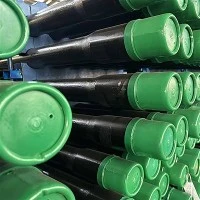
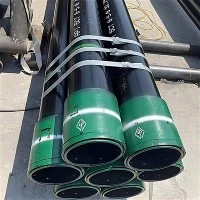
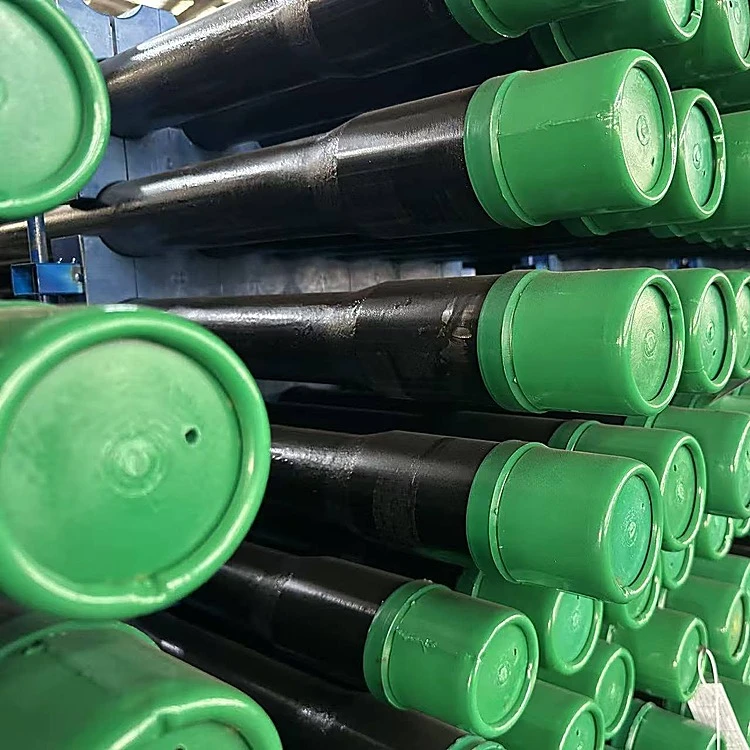

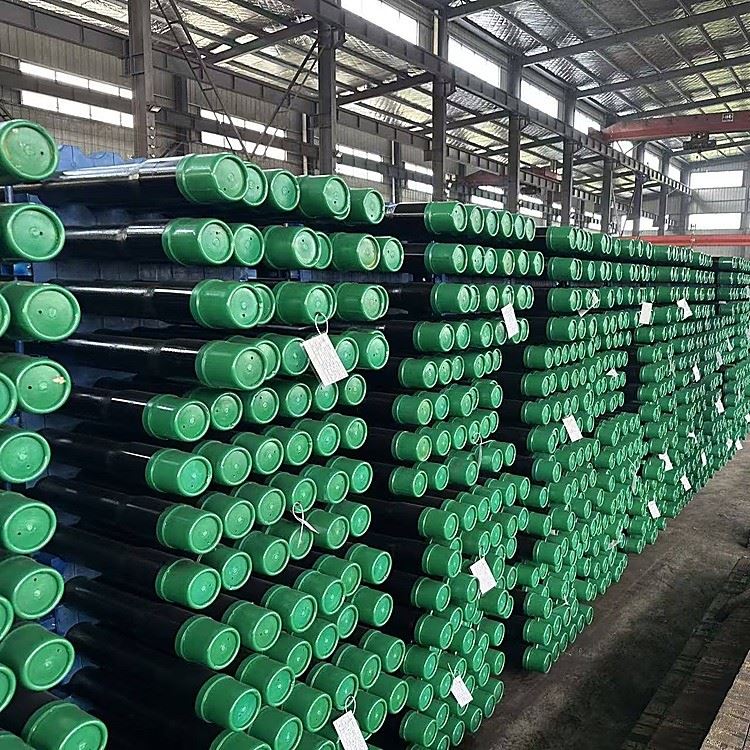
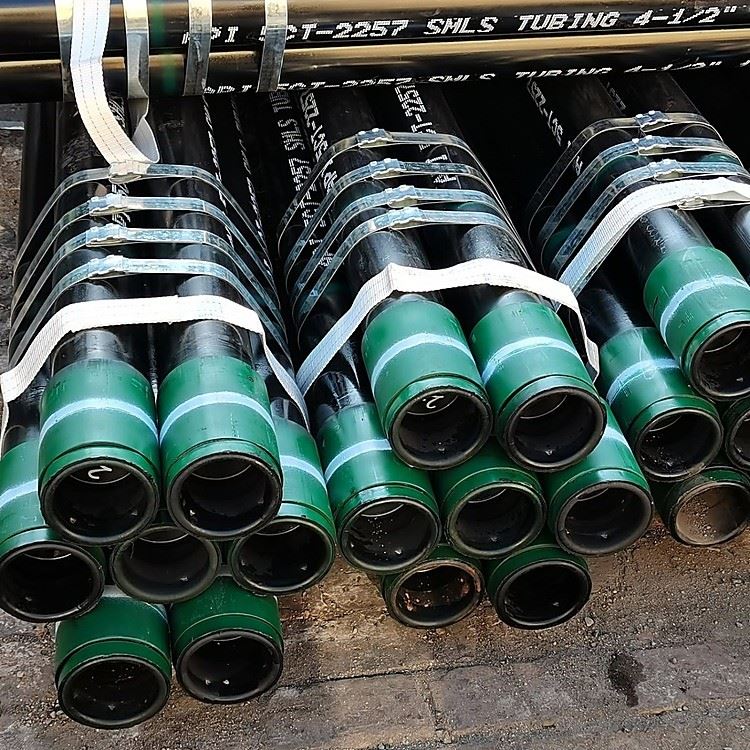
EUE Tubing
End form: External upset (EU)
Thread: API 8-round, 5B
OD range: 1.900 - 4-1/2 in
Common grades: J55 / N80 / L80 / P110
Joint: Threaded and coupled
EUE tubing - external upset end tubing - is the most widely used form of API 5CT tubing for oil and gas tubing strings. It is a steel pipe whose two ends are heated and forged thicker on the outside, so that the API 8-round thread cut into that upset wall leaves a joint at least as strong as the pipe body. Supplied to API Spec 5CT / ISO 11960 and threaded to API Spec 5B, EUE tubing is a finished product - pipe plus coupling - ordered by outside diameter, nominal weight, grade, length range and connection. It is the default oil well tubing and oil field tubing connection for the standard sizes up to 4-1/2 in, and it is bought as octg tubing alongside casing and drill pipe.
What Is EUE Tubing: API 5CT Tubing for Oil and Gas Tubing
EUE tubing is a length of api 5ct tubing whose two ends have been upset - heated and compressed - so the outside diameter is locally enlarged and the wall is thicker where the thread will be cut. An API 8-round thread removes a portion of the wall; without the upset the joint would be the weakest point in the string. External upsetting puts metal back at exactly that location, which is why an EUE joint is designed to be as strong as or stronger than the pipe body.
OCTG Tubing Names and Where EUE Fits
In the field this product is ordered under several overlapping names. A buyer may call it oil well tubing, oil field tubing, production tubing or simply octg tubing; all refer to the same article of commerce when it is supplied with an external upset end to API Spec 5CT / ISO 11960. The term EUE describes the end and the connection, not a separate steel grade, so the grade and the wall still have to be stated on the order.
EUE Tubing Specification
Table 0 - EUE tubing consolidated specification (ordering reference)
| Field | Specification / option |
|---|---|
| Product | EUE tubing, external upset end |
| Standard | API Spec 5CT / ISO 11960; thread to API Spec 5B |
| Sizes | 1.900, 2-3/8, 2-7/8, 3-1/2, 4, 4-1/2 in |
| Nominal weight | 2.75 - 12.60 lb/ft by size |
| Grades | J55, K55, N80-1/Q, L80 Type 1, L80 13Cr, C110, T95, P110 |
| Connection | API 8-round EUE with coupling; NUE available on small sizes |
| Thread pitch | 8 TPI (2-3/8 in and above); 10 TPI on 1.900 in |
| Thread taper | 1:16 (0.75 in per foot) |
| Length range | R1 6.10-7.32 m; R2 7.32-8.53 m; R3 9.75-10.36 m (API 5CT) |
| Drift | Per API 5CT drift mandrel for the selected weight/grade |
| Certificates | EN 10204 3.1 (3.2 on request); API 5CT monogram evidence |
| Sour service | NACE MR0175 / ISO 15156 where H2S is present |
Values are specification ranges, not one ordered size. Confirm the exact size, wall, grade, thread and edition of the standard against the purchase order and the mill certificate.
API Tubing Connections: EUE Versus NUE
The two standard API tubing connections differ in the end preparation and in the coupling envelope. EUE carries an external upset and a larger coupling; NUE keeps the body diameter and uses a smaller coupling. Among api tubing connections, EUE is the general-purpose choice and NUE is reserved for clearance-limited strings.
Representative API 5CT coupling outside diameters for standard connections. A special-clearance coupling is available on some sizes; confirm the exact coupling envelope against the casing drift and any downhole restriction before running the string.
The larger EUE coupling means the running outside envelope is set by the coupling, not by the pipe body. For octg tubing run through restrictive completions, the coupling OD must be checked against the casing drift, packer bore, safety valves and nipples. Where the metal-to-metal seal of a premium connection is required for gas-tight service, high combined loads or corrosion-resistant grades, EUE is no longer the correct choice and a licensed premium connection should be specified.
API Tubing Sizes and API Tubing Drift Sizes for Clearance
Api tubing drift sizes are the acceptance criterion for the bore. Drift is the minimum diameter that a standard mandrel must pass along the full length, and it is smaller than the nominal inside diameter because it includes the effect of manufacturing tolerance. Tools are selected against drift, not against a calculated bore.
Representative published values for the common weight line of each size. A heavier wall in the same outside diameter reduces the drift. Confirm the exact weight, grade and drift mandrel against the current standard and the approved completion design.
Three clearance checks follow from this. First, compare the largest completion tool with the tubing drift. Second, compare the EUE coupling outside diameter with the casing drift and every restriction on the run. Third, account for the upset end geometry and the make-up loss when the joint is fully screwed together. These checks are why api tubing sizes are never specified by diameter alone.
API Tubing Dimensions and Chemical Composition
Api tubing dimensions cover the pipe body, the upset and the coupling as one system. The upset outside diameter and length, the coupling outside diameter and the thread are all controlled by the standard. The chemistry below is the typical mill range for the common grades; the certificate for the delivered heat is the controlling document.
| Grade | C | Mn | P max | S max | Si | Others |
|---|---|---|---|---|---|---|
| J55 / K55 | 0.34-0.39 | 1.20-1.50 | 0.030 | 0.030 | 0.20-0.35 | Cu/Ni/Cr residual |
| N80-1 / Q | 0.34-0.38 | 1.45-1.70 | 0.030 | 0.030 | 0.20-0.35 | Cr, Ni, Cu each <= 0.15 |
| L80 Type 1 | 0.34-0.44 | 0.40-0.70 | 0.020 | 0.030 | 0.20-0.35 | Cr 0.80-1.10 |
| P110 | 0.26-0.35 | 1.15-1.55 | 0.020 | 0.010 | 0.20-0.35 | Cr, Ni, Cu residual |
Typical mill chemistry for guidance only. API Spec 5CT / ISO 11960, the product specification level and any sour-service hardness restriction govern the delivered order.
API Tubing Grades and Mechanical Properties
Api tubing grades are chosen for depth, pressure and corrosion, not by price per tonne. The mechanical minima below are the published API 5CT values for general-purpose grades. Oil and gas tubing in J55 or N80 handles most land wells; deeper or corrosive service moves the specification upward.
| Grade | Yield min | Yield max | Tensile min | Typical duty |
|---|---|---|---|---|
| J55 | 379 MPa / 55 ksi | 552 MPa / 80 ksi | 517 MPa / 75 ksi | Shallow to medium wells |
| K55 | 379 MPa / 55 ksi | 552 MPa / 80 ksi | 655 MPa / 95 ksi | Higher tensile demand |
| N80-1 / Q | 552 MPa / 80 ksi | 758 MPa / 110 ksi | 689 MPa / 100 ksi | Deeper, higher load |
| L80 Type 1 | 552 MPa / 80 ksi | 655 MPa / 95 ksi | 655 MPa / 95 ksi | Sour (H2S) service |
| C110 | 758 MPa / 110 ksi | 827 MPa / 120 ksi | 758 MPa / 110 ksi | Deep sour service |
| P110 | 758 MPa / 110 ksi | 965 MPa / 140 ksi | 862 MPa / 125 ksi | Deep, high pressure |
Published minima for selection guidance. Collapse and burst must be checked against the design code and the actual wall; grade alone does not define the rating.
For sour service, specify a hardness-controlled grade such as L80 Type 1 or C110 with conformity to NACE MR0175 / ISO 15156. For CO2-bearing condensate, L80 13Cr is the common EUE specification. The N80 oil well tubing and J55 OCTG tubing pages show the same grade logic at the general-duty end, while Q125 tubing normally uses a premium connection rather than EUE.
EUE Thread Form and Dimensional Tolerances
The EUE connection is cut to the API 8-round form in API Spec 5B: rounded crests and roots reduce stress concentration, the taper is 1:16, and the pitch is 8 TPI on sizes from 2-3/8 in upward with 10 TPI on the 1.900 in size. Seal is produced by flank-to-flank interference with thread compound. Gauging of the pin and coupling, together with make-up loss, must be recorded for the delivered lot.
| Item | Typical control / check |
|---|---|
| Pipe body OD | API 5CT tolerance band for the stated size |
| Wall thickness | -12.5% of nominal wall (API 5CT) |
| Drift | Full-length pass of the applicable API drift mandrel |
| Thread form | API 5B 8RD gauge (lead, taper, height) accepted |
| Coupling OD | Regular or special-clearance option stated |
| Length | R1 / R2 / R3 range as ordered |
| Make-up | Make-up loss and final torque recorded |
Values shown are common API controls for guidance. The applicable standard edition, product specification level and approved inspection plan set the acceptance limits for a delivered order.
How to Specify Oil Well Tubing and Oil Field Tubing
A clear oil well tubing enquiry states the outside diameter, nominal weight or wall, grade, connection (EUE), length range, drift requirement and quantity, plus the standard edition and any sour-service condition. The same line applies to oil field tubing bought for a workover or completion: the pipe may be identical, but the drift and coupling envelope must fit the tools and the casing programme.
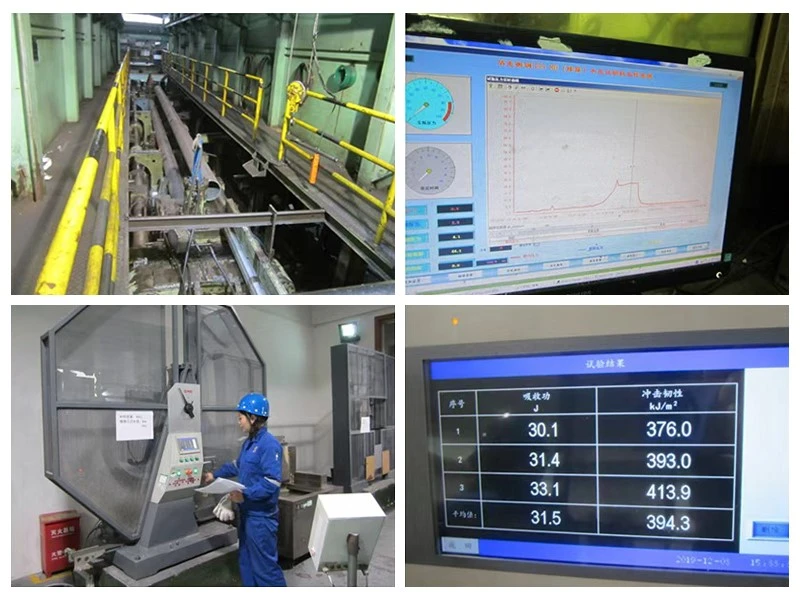
Ask for a mill test certificate to EN 10204 3.1 (3.2 when agreed), API 5CT / ISO 11960 and API 5B evidence, drift and dimensional records, and thread gauging results tied to the delivered heat. Short lengths in the same grade and connection, such as a pup joint, should be ordered with the main string so the envelope stays consistent. Where the well needs a gas-tight seal or corrosion-resistant grade, compare EUE against the licensed premium connection before the order is placed.
Tubing Test and Inspection
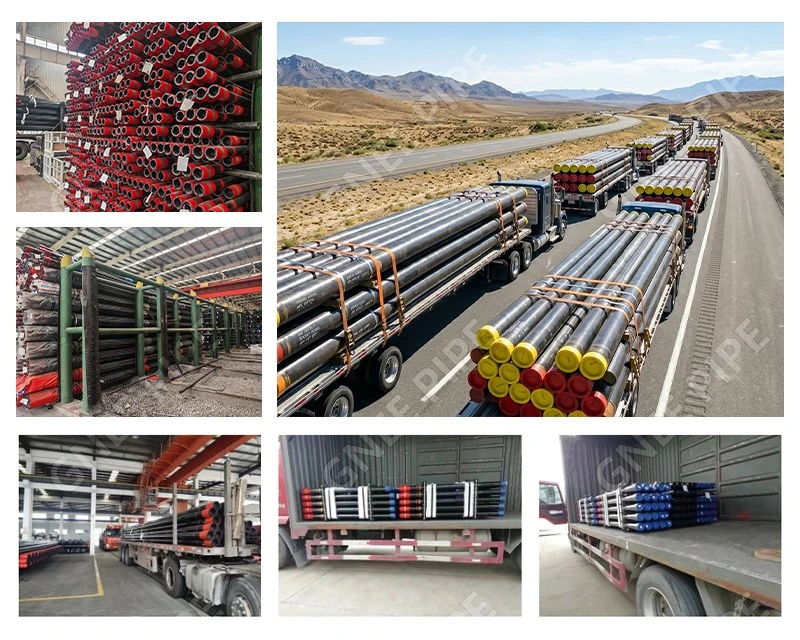
Packaging and shipping
Send the outside diameter, nominal weight or wall, grade, EUE thread, length range and specification level together with quantity and destination. A quotation can then be built against the exact API 5CT / ISO 11960 line, with upset dimensions, coupling, drift and certificate scope confirmed before the order is placed.
Request an EUE Tubing Quotation
Related Product
API 5CT J55 EUE Pipes For Borewell System
FAQ
What does EUE stand for on a tubing order?
EUE means external upset end. The pipe ends are heated and compressed so the wall thickens on the outside, and the thread is then cut into this heavier section. The name distinguishes it from NUE (non-upset), where the thread is cut into the plain body, and from IJ (integral joint), which has no separate coupling. EUE is the common threaded-and-coupled form for production tubing.
What is the difference between EUE and NUE tubing?
NUE (non-upset end) tubing is cut from the full-body wall with no end thickening, and uses a smaller coupling. EUE tubing has an external upset and a larger coupling outside diameter, giving a stronger joint at the cost of a bigger running envelope. For example at 2-3/8 in the NUE coupling OD is about 73.03 mm while the EUE coupling OD is about 77.80 mm; at 2-7/8 in the two are 88.90 mm and 93.17 mm respectively. NUE is normally chosen for slim-hole and rod-pump strings where clearance is tight.
Which steel grades are available in EUE tubing?
EUE tubing is supplied in the standard API 5CT grades from J55 and K55 through N80, L80, C110 and P110. J55 and N80 suit general oil and gas tubing service; L80 Type 1 or T95 and C110 are chosen for sour (H2S) service with conformity to NACE MR0175 / ISO 15156, and L80 13Cr is common in CO2-bearing gas condensate wells. Q125 is less often ordered in EUE because those high-load wells usually call for a premium metal-to-metal-seal connection.
Why is drift diameter so important when buying EUE tubing?
Drift diameter is the guaranteed minimum bore that a gauge mandrel must pass, and it controls whether pumps, packers, gauges and intervention tools can be run through the string. The nominal inside diameter is only a calculated value; drift is the acceptance value. Two tubing lines with the same outside diameter but different nominal weights have different drifts because the wall changes, so the weight and drift must be confirmed together before tools are selected.
What are the specifications for 2-7/8" EUE tubing?
The standard 2-7/8 in EUE line is 2.875 in (73.02 mm) outside diameter at 6.50 lb/ft, with a 0.217 in (5.51 mm) wall, about 2.441 in (62.00 mm) nominal inside diameter and a 2.347 in (59.61 mm) drift, joined by a coupling of about 93.17 mm outside diameter. It is cut with the API 8-round (8RD) EUE thread, commonly 8 threads per inch on a 1:16 taper, and is ordered in J55, L80, N80 or P110 with an R1, R2 or R3 length range. Heavier 7.90, 8.70 and 9.45 lb/ft walls are also listed in API 5CT; each changes the drift and the make-up torque, so quote the weight and grade together.
What is the make-up torque for 3 1/2" EUE tubing?
Make-up torque depends on both the grade and the nominal weight. For the common 3-1/2 in 9.30 lb/ft EUE 8RD joint, recommended values are about 1,710/2,280/2,850 ft-lb (minimum/optimum/maximum) in J55, 2,270/3,030/3,790 ft-lb in L80, 2,400/3,200/4,000 ft-lb in N80 and 3,170/4,230/5,290 ft-lb in P110. The heavier 12.95 lb/ft line takes roughly 3,150/4,200/5,250 ft-lb in L80 and 4,260/5,680/7,100 ft-lb in P110. These are starting figures from the API recommended torque tables; the crew should confirm the current edition and apply the thread compound, gauging and inspection class stated on the certificate before make-up.
What are the specifications for 2-3/8" EUE tubing?
A 2-3/8 in EUE tubing joint is 2.375 in (60.32 mm) outside diameter; the standard 4.70 lb/ft wall is 0.190 in (4.83 mm), giving about 1.995 in (50.67 mm) nominal inside diameter and a 1.901 in (48.29 mm) drift, with a coupling outside diameter near 77.80 mm. It uses the API 8-round EUE thread and is normally supplied in J55, N80, L80 or P110. API 5CT also lists heavier EU walls at 5.95 and 7.45 lb/ft; both reduce the drift (about 45.04 mm and 40.88 mm respectively), so the tool clearance must be checked against the ordered weight, not just the nominal size.
Hot Tags: eue tubing, China eue tubing manufacturers, suppliers, factory
Previous
API 5CT Casing PipeYou Might Also Like


Send Inquiry