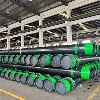
5-1/2 Casing Dimensions and Size Chart
What dimensions are specified for a 5-1/2 casing pipe?
The same 139.7 mm casing body carries four published weights. Each step adds wall, raises collapse and burst capacity, and takes bore away. The spread is only 7.11 mm of inside diameter, which is smaller than on a surface-casing size, but it is enough to decide which completion tools will pass. Drift moves with it: 122.56 mm at 15.50 lb/ft down to 115.44 mm at 23.00 lb/ft.
Table 1 - API 5CT 5-1/2 in. casing dimensions and weight
| lb/ft | Wall (in) | Wall (mm) | ID (mm) | Drift (mm) | Drift (in) | kg/m |
|---|---|---|---|---|---|---|
| 15.50 | 0.275 | 6.98 | 125.73 | 122.56 | 4.825 | 23.07 |
| 17.00 | 0.304 | 7.72 | 124.26 | 121.08 | 4.767 | 25.30 |
| 20.00 | 0.361 | 9.17 | 121.36 | 118.18 | 4.653 | 29.76 |
| 23.00 | 0.415 | 10.54 | 118.62 | 115.44 | 4.545 | 34.23 |
Nominal ID = OD - 2 x wall. Drift is the API mandrel clearance value, 3.18 mm (0.125 in.) below nominal ID at this size. Verify the exact combination against the current API 5CT / ISO 11960 edition before it is written into a purchase order.
5-1/2 Casing Weight Per Foot - What the Numbers Mean
A 5-1/2 casing pipe is ordered by designation rather than by wall: the weight in a casing designation is not a measured weight of one foot of tube. It is a nominal threaded-and-coupled label that identifies an API size-and-mass combination. The plain-end mass calculated from the wall is lower, and the difference is the mass gain from the upset, thread and coupling - positive on the lighter walls and still present, in smaller form, on the heavier ones. Confusing the two changes the tonnage on an order and the hook load on a string.
Table 2 - Mass designation versus plain-end mass at 139.70 mm OD
| Designation (lb/ft) | Plain end (lb/ft) | T&C (lb/ft) | Mass gain (lb/ft) | Gain per 12 m joint (kg) |
|---|---|---|---|---|
| 15.50 | 15.31 | 15.50 | 0.19 | 3.39 |
| 17.00 | 16.87 | 17.00 | 0.13 | 2.32 |
| 20.00 | 19.81 | 20.00 | 0.19 | 3.39 |
| 23.00 | 22.54 | 23.00 | 0.46 | 8.21 |
Plain-end mass follows the API linear-mass relation 10.68 x (OD - t) x t, with OD and t in inches. The gain depends on the connection, so the same pipe with STC, LTC or BTC does not weigh exactly the same as a finished joint.
This is why a 5-1/2 casing weight question cannot be answered with one number. At 15.50 lb/ft the plain end is 15.31 lb/ft and the coupling adds about 0.19 lb/ft of labelled mass; at 23.00 lb/ft the plain end is 22.54 lb/ft and the gain is about 0.46 lb/ft. The heavier wall does not remove the connection. A buyer who converts the designation into tonnage without saying which connection is being supplied will quote a different weight from the mill.
How to Read the 5-1/2 Casing Table
Casing Drift Diameter and the 7 in. Restriction
Drift is a clearance-test value, not a measured minimum ID. At 5-1/2 in. the API drift mandrel sits 3.18 mm below nominal ID, so the table above gives the first-pass answer to a tool-clearance question. The second question is the one that stops a string: the coupling is wider than the pipe body, and it has to pass through every restriction above it.
A 5-1/2 coupling measures 153.67 mm across. Against the drift of a 7 in. intermediate string the nominal clearance is 4.85 mm at 7 in. 23 lb/ft, 2.57 mm at 26 lb/ft and 0.23 mm at 29 lb/ft. At 7 in. 32 lb/ft the coupling is 2.06 mm too large and will not enter. That is a dimensional result, not a strength result: a heavier 7 in. wall can make the 5-1/2 string unrunnable even though the pipe grades are adequate.
Table 3 - 5-1/2 coupling against 7 in. casing drift
| 7 in. casing (lb/ft) | 7 in. drift (mm) | 5-1/2 coupling OD (mm) | Nominal clearance (mm) | Result |
|---|---|---|---|---|
| 23.00 | 158.52 | 153.67 | 4.85 | passes |
| 26.00 | 156.24 | 153.67 | 2.57 | passes |
| 29.00 | 153.90 | 153.67 | 0.23 | passes |
| 32.00 | 151.61 | 153.67 | -2.06 | will not pass |
Clearance is a diameter difference on paper. Ovality, scale, a mandrel that has seen service and a coupling with protective coating all consume it; treat figures under about 1 mm as no working clearance at all.
Will the coupling clear your 7 in. string? Send the drift of the intermediate casing and the end finish you plan to run, and the reply states the clearance for STC, LTC and BTC on that exact 5-1/2 weight - not a general yes. Send the casing drift before the connection is fixed.
5-1/2 Casing Coupling Specifications
All three API connections at this size use the same 153.67 mm coupling outside diameter. What changes is length and mass: the short round coupling is 171.45 mm, the long round 203.20 mm and the buttress 234.95 mm. The longer engagement of LTC and the load flank of BTC buy joint strength at the cost of a longer envelope and more thread compound to make up. STC remains the light option for shallow, low-tension strings.
Connection Designation and Full Name
Table 4 - API connections available on 5-1/2 in. casing
| Designation | Full name | Coupling OD (mm) | Length (mm) | Coupling mass (kg) | Thread standard |
|---|---|---|---|---|---|
| STC / SC | Short round thread casing | 153.67 | 171.45 | 5.23 | API 5B |
| LTC / LC | Long round thread casing | 153.67 | 203.20 | 6.42 | API 5B |
| BTC / BC | Buttress thread casing | 153.67 | 234.95 | 6.36 | API 5B |
Coupling masses are catalog values for standard couplings. Premium connections are manufacturer-specific and are not interchangeable with any of these three.
A 5-1/2 string can therefore be quoted with any of the three threads, but not as a generic "casing coupling" line. LTC and BTC do not carry the same joint rating, and a premium connection will have its own drift, torque and inspection criteria. The connection also decides the mass gain in Table 2, so it belongs on the first inquiry rather than after the price is agreed.
Ask for the data sheet and it comes back with the four weight rows, the drift and coupling envelopes, the grade limits and the tolerance columns in one printable file - the form a technical bid or a receiving inspection can actually attach.
Get the 5-1/2 casing specifications PDF
API Casing Grades, Strength Properties and Service Considerations
API 5CT casing grades at this size run from J55 to Q125, and yield strength is only one input into the selection. It does not set collapse performance, connection capacity or resistance to sulfide stress cracking, and a higher grade is not a remedy for a corrosive environment. At 5-1/2 in. the grades most often met are J55 and K55 for lower-load production, N80 and L80 for deeper or sour service, and P110 where collapse governs in the heavier walls.
Table 5 - Mechanical requirements by grade (API 5CT)
| Grade | Yield min (MPa) | Yield max (MPa) | Tensile min (MPa) | Hardness max | Typical use here |
|---|---|---|---|---|---|
| J55 | 379 | 552 | 517 | Not specified | Shallow production casing |
| K55 | 379 | 552 | 655 | Not specified | Same yield, higher tensile for the thread |
| N80-1 / N80Q | 552 | 758 | 689 | Not specified | Deeper production, higher collapse |
| L80-1 | 552 | 655 | 655 | 23 HRC | Sour service, hardness controlled |
| C90-1 | 621 | 724 | 689 | 25.4 HRC | Sour service with higher load |
| T95-1 | 655 | 758 | 724 | 25.4 HRC | Sour service, heavy wall |
| P110 | 758 | 965 | 862 | Not specified | High collapse in the 20 and 23 lb/ft walls |
| Q125-1 | 862 | 1,034 | 931 | Not specified | Special-order high-pressure interval |
Hardness ceilings apply to the sour-service grades. A grade without a hardness limit is not qualified for H2S merely because its yield is high; check the service against ISO 15156 / NACE MR0175 as well as the grade table.
Table 6 - Chemical requirements, maximum unless a range is given (%)
| Grade | C | Mn | Mo | Cr | Ni | P | S |
|---|---|---|---|---|---|---|---|
| J55, K55, N80-1, N80Q | NL | NL | NL | NL | NL | 0.030 | 0.030 |
| L80-1 | 0.43 | 1.90 | NL | NL | 0.25 | 0.030 | 0.030 |
| C90-1 | 0.35 | 1.20 | 0.25-0.85 | NL | 0.99 | 0.020 | 0.010 |
| T95-1 | 0.35 | 1.20 | 0.25-0.85 | 0.40-1.50 | 0.99 | 0.020 | 0.010 |
| P110 | NL | NL | NL | NL | NL | 0.030 * | 0.030 * |
| Q125-1 | 0.35 | 1.35 | 0.85 | 1.50 | 0.99 | 0.020 | 0.010 |
NL = no limit. * Electric-welded P110 is held to 0.020 % P and 0.010 % S. L80-1 also carries 0.45 % maximum silicon and 0.35 % maximum copper. Use the current edition of API 5CT Table E.5 for the exact order conditions.
Does the certificate match the joint? Ask for a sample certificate for the grade you intend to order, and read it before the tonnage is committed: which part of EN 10204 applies, whether the API monogram is stamped on the joint and not only on the paperwork, and whether the heat number on the sample matches the joint that will ship.
API 5CT Standard and Data Notes
For API 5CT casing, the product, dimensions, grades, testing and marking are set by API 5CT / ISO 11960; API 5B sets the thread dimensions and gauging. For sour service the environment is assessed under ISO 15156 / NACE MR0175, and a mill certificate is written to EN 10204 3.1, or 3.2 when the order asks for it. These are separate documents and none substitutes for another. The 11th edition of API 5CT removed the former formal PSL structure, so an old PSL phrase should not be copied into a new order without checking what the current edition actually requires.
Table 7 - Dimensional and mass tolerances applied to 5-1/2 in. casing
| Item | Allowed variation | Basis | What to check on arrival |
|---|---|---|---|
| Outside diameter | +/- 1 % of nominal (about +/- 1.40 mm) | API 5CT dimensional table | Measure at both ends and mid-body |
| Wall thickness | -12.5 % of nominal wall | API 5CT dimensional table | Four points at each end, deepest reading governs |
| Mass, single joint | -3.5 % / +6.5 % of nominal | API 5CT mass tolerance | Weigh a sample against the designation, not the plain-end figure |
| Length, Range 3 | 10.36-14.63 m | API 5CT length ranges | Confirm the spread inside the delivered lot |
| Drift | API drift mandrel, minimum 1.83 m long | API 5CT / API RP 5A5 | Pass the full body and re-check from the coupling end after make-up |
| Straightness | Deviation limited by API 5CT | API 5CT dimensional table | Roll the joint and record any bow before acceptance |
Tolerance figures are the commonly applied API values for this product; the governing edition and any supplementary requirement in the purchase order take precedence.
Your offer is per joint, theirs is per ton? A 12 m joint at 15.50 lb/ft is 0.28 t and the same length at 23.00 lb/ft is 0.41 t, plain end - before the connection gain is added. Send the weight and the thread, and work out the tonnage on the same basis for both offers.
Using the Table for Preliminary Casing Selection
An inquiry that names the following items comes back as an offer that can be read line by line. Leaving any one open lets two suppliers fill it in differently and produce two prices that look comparable but are not.
OD and weight written together, for example 5-1/2 in. x 20.00 lb/ft
Grade and type: J55, K55, N80-1, N80Q or L80-1, named rather than left as "API 5CT"
Connection designation: STC, LTC or BTC, with the coupling drift requirement stated
Casing length range R1, R2 or R3 and the acceptable spread within it
Certificate basis: EN 10204 3.1 or 3.2, API monogram if required, and the heat-number traceability
Quantity in joints or meters, with the tonnage basis - plain end or threaded and coupled - written out
Every joint supplied against this page is new, unrun pipe: it has not been downhole, the ends have not been re-cut and the stencil has not been re-applied, and each heat is traced to its mill test certificate. On arrival, match the stencil and heat number to the certificate, check the coupling outside diameter at 153.67 mm and the make-up length, verify wall and drift, and look for large tong marks or a bright re-threaded band before the joints are racked.
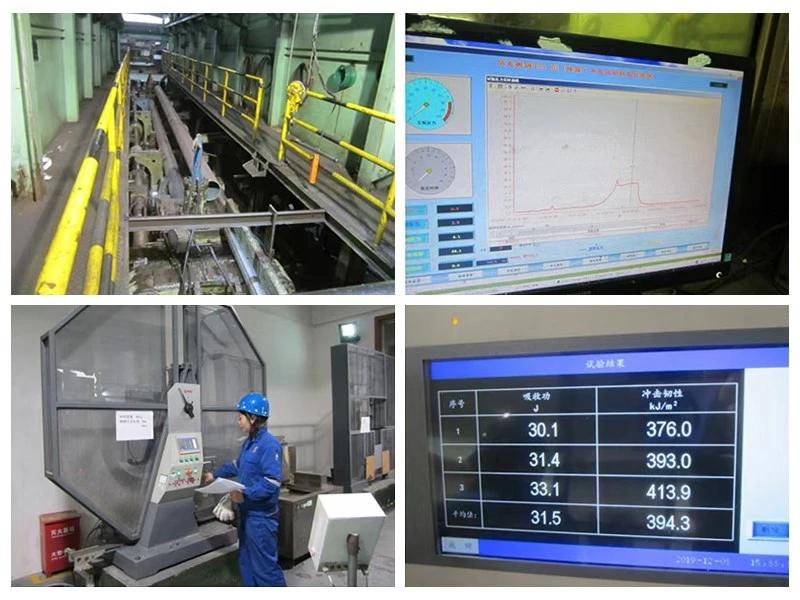
Oil and Gas Well Casing Pipe test and inspection
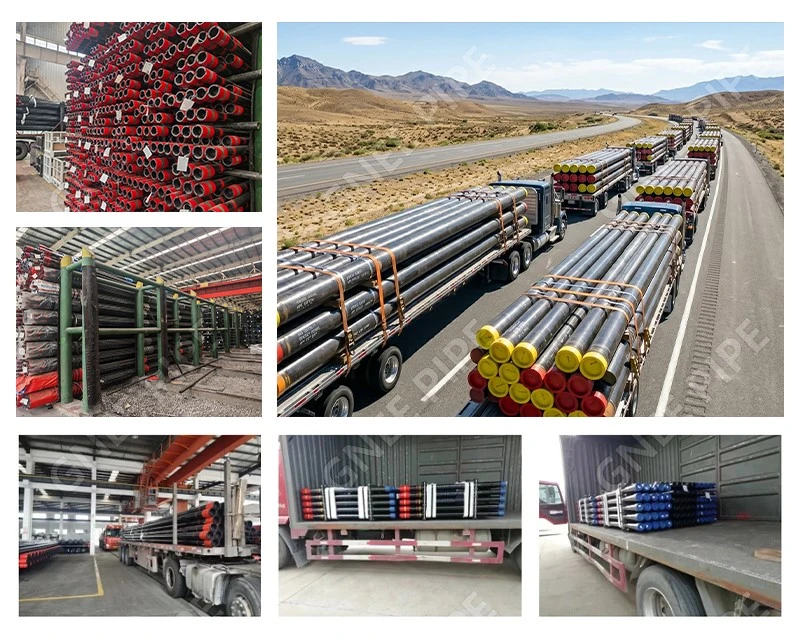
Casing Pipe Packaging and Shipping
Related Product
FAQ
What does 5-1/2 in. mean on a casing data sheet?
It is the nominal outside diameter: 5.500 in. or 139.70 mm. It is neither a bore nor a thread size. The weight designation that follows it fixes the wall, the inside diameter and the drift, so a 5-1/2 joint at 15.50 lb/ft and one at 23.00 lb/ft share the same outside and differ by 7.11 mm of inside diameter.
Can a 5-1/2 casing coupling pass through 7 in. casing?
It depends on the weight of the 7 in. string. The 5-1/2 coupling is 153.67 mm across; the drift of 7 in. casing runs from 158.52 mm at 23 lb/ft to 151.61 mm at 32 lb/ft. It passes the first three with 4.85, 2.57 and 0.23 mm of nominal clearance and will not pass the 32 lb/ft string. A margin of 0.23 mm is not a working clearance once ovality and coating are considered.
Is long round thread available on 5-1/2 in. casing?
Yes. Unlike the larger casing sizes where long round thread stops, 5-1/2 in. is supplied with STC, LTC and BTC. The three share a 153.67 mm coupling outside diameter but not the same coupling: 171.45 mm, 203.20 mm and 234.95 mm long respectively. State the designation on the inquiry.
Why are there more weight options at 5-1/2 in. than at 13-3/8 in.?
Because 5-1/2 is a production string and has to be designed against collapse, burst and tension at depth, while a large surface string is mostly sized by the hole it has to seal and the weight it has to carry. The common 5-1/2 ladder is 15.50, 17.00, 20.00 and 23.00 lb/ft, with heavier walls listed in the API tables above that; 13-3/8 is normally bought in five steps from 48 to 72 lb/ft.
How much does a 12 m joint of 5-1/2 casing weigh?
About 0.28 t at 15.50 lb/ft, 0.30 t at 17.00, 0.36 t at 20.00 and 0.41 t at 23.00, calculated on the nominal designation with the coupling excluded. These are planning figures: a single joint may legally vary below and above the designation, and the finished threaded-and-coupled mass differs from the plain-end mass.
Is 5-1/2 in. casing the same product as 5-1/2 in. tubing?
No. The standard API 5CT tubing sizes stop at 4-1/2 in., so a 5-1/2 in. tubing designation is a misread of the product. The 5-1/2 in. designation here is casing, the outer production string, while tubing is the smaller string run inside it. API 5L line pipe is a third product at the same diameter. Name the specification as well as the size on the order.