


API 5L is for transporting oil and gas (Line Pipe), while API 5CT is for extracting oil and gas (Casing and Tubing).
Buying the wrong pipe standard can lead to project failure. Learn the common pitfalls in choosing between API 5L and API 5CT for your energy project.
Quick Comparison Table: API 5L vs. API 5CT
| Feature | API 5L | API 5CT |
| Common Name | Line Pipe | OCTG (Casing and Tubing) |
| Primary Function | Transporting resources over distances. | Drilling and extracting resources from wells. |
| Steel Grades | Grade B, X42, X52, X60, X70, etc. | J55, K55, N80, L80, P110, Q125, etc. |
| End Connections | Beveled, Plain, or Socket (Welded). | Threaded and Coupled (T&C) or Premium. |
| Product Levels | PSL1 and PSL2. | Groups 1, 2, 3, and 4. |
| Pipe Types | Seamless, ERW, LSAW, SSAW. | Seamless and Welded (ERW). |
What is API 5L? (Line Pipe)
The API 5L standard serves as the core standard for line pipe, providing detailed specifications regarding manufacturing processes, mechanical properties, chemical composition, dimensions, and other parameters.
According to the API 5L standard, line pipes are classified into two levels: API 5L PSL1 and API 5L PSL2. In this context, PSL stands for Product Specification Level.
Tensile & Yield Strength (PSL1 vs. PSL2)
| Steel Grade | Yield Strength (Min - MPa/psi) | Tensile Strength (Min - MPa/psi) | Yield-to-Tensile Ratio (PSL2 Max) |
| Grade B | 245 / 35,500 | 415 / 60,200 | 0.93 |
| X42 | 290 / 42,100 | 415 / 60,200 | 0.93 |
| X52 | 360 / 52,200 | 460 / 66,700 | 0.93 |
| X60 | 415 / 60,200 | 520 / 75,400 | 0.93 |
| X65 | 450 / 65,300 | 535 / 77,600 | 0.93 |
| X70 | 485 / 70,300 | 570 / 82,700 | 0.93 |
| X80 | 555 / 80,500 | 625 / 90,600 | 0.93 |
Chemical Limits for PSL2 (Heat Analysis, Max %)
| Element | Grade B | X52 | X65 | X70 |
| Carbon (C) | 0.22 | 0.22 | 0.22 | 0.22 |
| Manganese (Mn) | 1.20 | 1.40 | 1.45 | 1.65 |
| Phosphorus (P) | 0.025 | 0.025 | 0.025 | 0.025 |
| Sulfur (S) | 0.015 | 0.015 | 0.015 | 0.015 |
| Carbon Equivalent (CE) | 0.43 | 0.43 | 0.43 | 0.43 |
API 5L Dimensional Tolerance Requirements
| Parameter | Size Range | Tolerance |
| Outside Diameter (OD) | < 2 3/8" (60.3mm) | ± 0.5mm (0.020") |
| 2 3/8" to 24" | ± 0.75% of OD | |
| > 24" | ± 1.0% of OD | |
| Wall Thickness (WT) | All Sizes | +15% / -12.5% |
| Straightness | All Sizes | ≤ 0.2% of total length |
GNEE API 5L pipeline in stock

What is API 5CT? (Casing and Tubing)
Casing
Casing is the large-diameter pipe that is lowered into an open borehole and cemented in place. Its job is to stabilize the well, prevent the walls from caving in, and protect groundwater from contamination.
Tubing
Tubing is the pipe used to transport the oil and gas from the producing reservoir up to the surface. It must be strong enough to withstand the internal pressures and corrosive fluids found deep underground.
API 5CT Steel Grades & Groups
| Group | Steel Grades | Description & Application |
| Group 1 | H40, J55, K55, N80 | Standard grades for general purpose in shallow to mid-depth wells. |
| Group 2 | L80, C90, T95, C110 | Restricted yield strength grades for Sour Service (H2S) environments. |
| Group 3 | P110 | High-strength grade for deep wells and high-pressure environments. |
| Group 4 | Q125 | Ultra-high strength for specialized, demanding well conditions. |
Mechanical Properties (Tensile & Hardness)
| Steel Grade | Yield Strength (Min-Max - psi) | Tensile Strength (Min - psi) | Hardness (Max - HRC) |
| H40 | 40,000 - 80,000 | 60,000 | N/A |
| J55 | 55,000 - 80,000 | 75,000 | N/A |
| K55 | 55,000 - 80,000 | 95,000 | N/A |
| N80-1/Q | 80,000 - 110,000 | 100,000 | N/A |
| L80-1 | 80,000 - 95,000 | 95,000 | 23.0 |
| C90-1 | 90,000 - 105,000 | 100,000 | 25.4 |
| P110 | 110,000 - 140,000 | 125,000 | N/A |
| Q125 | 125,000 - 155,000 | 135,000 | N/A |
Chemical Composition (Heat Analysis, Max %)
| Element | J55 / K55 | N80-Q | L80-1 | P110 |
| Carbon (C) | Per Agreement | Per Agreement | 0.43 | Per Agreement |
| Manganese (Mn) | Per Agreement | 1.90 | 1.90 | 1.90 |
| Phosphorus (P) | 0.030 | 0.030 | 0.030 | 0.030 |
| Sulfur (S) | 0.030 | 0.030 | 0.030 | 0.030 |
API 5CT Color Coding (Identification)
| Steel Grade | Pipe Body Color Band | Coupling Color |
| J55 | One Bright Green | Bright Green |
| K55 | Two Bright Green | Bright Green |
| N80-Q | One Red + One Bright Green | Red |
| L80-1 | One Red + One Golden | Red + Golden |
| P110 | One White | White |
| Q125 | One Orange | Orange |
API 5CT Connection Types
STC (Short Threaded and Coupled): Used for shorter casing strings.
LTC (Long Threaded and Coupled): Standard for most casing applications.
BTC (Buttress Threaded and Coupled): Designed for high axial tension loads.
Premium Connections: Gas-tight seals for high-pressure/high-temperature (HPHT) wells.
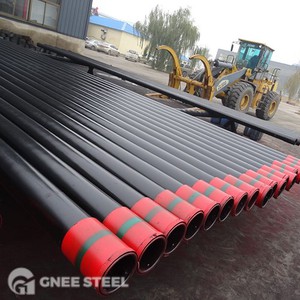
GNEE API 5CT OCTG pipe in stock
FAQ
What is API 5L used for?
ANSI / API 5L specifies the manufacture of two product levels (PSL1 and PSL2) of seamless and welded steel pipe for the use of a pipeline in the transportation of petroleum and natural gas.
What does API 5CT stand for?
API 5CT is a standard technical specification for steel tubes for casing and tubing used in the oil and gas industry and was developed by the American Petroleum Institute for casing and tubing.
Is API 5L pipe carbon steel?
API 5L is a standard for steel pipes that are designed for transporting oil and gas. These pipes are made from carbon steel and are available in two different types: seamless and welded (including ERW and SAW).


