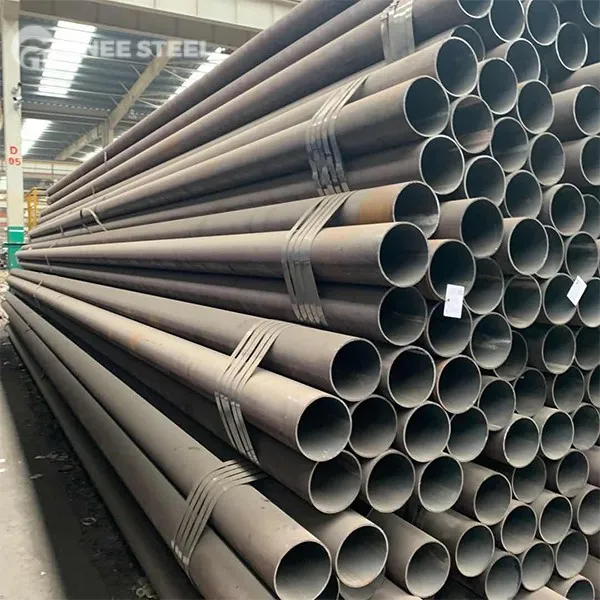
DIN1629,EN10210,EN10216,A53 Structural Tubes refer to tubular products used in construction structures to bear loads and withstand pressure. Owing to their excellent load-bearing capacity and stability, these pipes are widely utilized in various construction and engineering projects.
The primary material for structural tubes is typically steel, which undergoes specialized processing and treatment to achieve high compressive and tensile strength. This enables them to effectively resist external pressures, ensuring the stability and safety of buildings.
Beyond their basic load-bearing function, structural tubes also exhibit good ductility and weldability, providing high flexibility in construction. They can be shaped and connected according to diverse design requirements. Additionally, structural tubes offer a long service life, maintaining performance stability even in harsh environments, making them an indispensable material in construction engineering.
specification
Diameter: 114MM-914MM
Thickness: 4MM-60MM
Length: According to your requirements
Specification: 114-914MM X 4-60MM
Country of origin: China
Type: Seamless steel pipe
Special pipe: Regular and special thick-walled structure steel pipe, maximum thickness of up to 60MM
Process: Hot rolled and hot expanded
| Standard | Grade |
| GB/T8162 | 10#,20#,35#,45#,Q345A,Q345B,Q345C,Q345D,Q345E |
| DIN1629 | St370,St440,St55,St520,CK45 |
| ASTM A106 | GR.A,GR.B,GR.C |
| ASTM A53 | GR.A,GR.B |
| EN10216 | P195GH,P235GH,P265GH |
| EN10210 | S235JRH,S275J0H,S355JRH,S275J2H |
Process of Structural Pipe
I. Raw Material Batching
Seamless structural steel pipes are a critical industrial product in the steel industry, primarily made from high-quality steel billets. First, the billets are fed into a batching machine and mixed with raw materials such as limestone, iron oxide, and carbon in predetermined proportions. The mixture is then transported to a blast furnace for heating, producing blast furnace slag and pure iron.
II. Rolling
The blast furnace slag and pure iron are combined and further refined into formed steel billets. After preheating, the billets enter rolling mills, where they are rolled into formed steel pipes under high temperature and pressure. The key to this process lies in the precision and control capability of the rolling mill-only ensuring high quality at this stage can guarantee the quality of subsequent processes.
III. Pickling
After rolling into formed pipes, pickling treatment is performed. This step primarily removes surface oxides and rust to ensure smooth progress in the cold drawing process. During pickling, acids, alkalis, and other cleaning agents are used to achieve a smoother surface finish.
IV. Cold Drawing
Following pickling, the formed pipes enter cold drawing units for processing. In this process, machines stretch the metal particles inside the pipe to reduce its diameter while achieving more uniform wall thickness. The key here lies in machine coordination and technical operation-mastery of these ensures dimensional accuracy and quality in the final product.
V. Heat Treatment
After cold drawing, the formed pipes undergo heat treatment. This step aims to adjust the size and structure of internal metal crystals to meet standards for hardness, toughness, and other mechanical properties. The heat treatment process includes heating, soaking, and cooling stages, requiring precise control of temperature, time, and other factors to ensure final product quality.
GNEE Structural pipe for sale