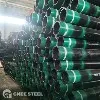
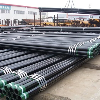
While L80 and N80 (both N80-1 and N80-Q) share the same minimum yield strength of 80,000 psi, they are very different materials. The most critical difference is that L80 is designed for sour service (environments with H2S ), while N80 is for sweet service (non-corrosive environments).
Unsure if L80 or N80 is Right for Your Project? Consult Our Technical Experts for a Custom Recommendation.
API 5CT L80 is a restricted-yield steel grade used for casing and tubing in the oil and gas industry. It belongs to Group 2 under the API 5CT specification and is specifically designed for Sour Service (environments containing Hydrogen Sulfide, H2S).
Core Characteristic: The defining feature of L80 is not just its strength, but its controlled hardness. API mandates that the Rockwell hardness must not exceed 23.0 HRC. This restriction prevents Sulfide Stress Cracking (SSC) in high-sulfur environments.
Heat Treatment: L80 must undergo full-length Quenching and Tempering (Q&T) to ensure a uniform microstructure and consistent mechanical properties.
Main Types:
L80 Type 1: The standard carbon steel version, primarily used for H2S resistance.
L80 9Cr: Contains 9% Chromium for moderate resistance against Carbon Dioxide (CO2) corrosion.
L80 13Cr: Contains 13% Chromium (Martensitic Stainless Steel), specifically designed for high-temperature environments with severe CO2 corrosion.
Applications: Used in medium-to-deep wells with high pressure and corrosive H2S or CO2 presence.
Technical Parameter Tables for L80 OCTG Casing
Mechanical Properties Table
| Parameter | Imperial Units (psi) | Metric Units (MPa) |
| Yield Strength - Minimum | 80,000 psi | 552 MPa |
| Yield Strength - Maximum | 95,000 psi | 655 MPa |
| Tensile Strength - Minimum | 95,000 psi | 655 MPa |
| Hardness - Maximum | 23.0 HRC | -- |
| Elongation | Per API 5CT Formula | -- |
Chemical Composition Table (% Max unless range specified)
The chemical makeup varies significantly between the three L80 types:
| Element | L80 Type 1 (Carbon) | L80 9Cr (Alloy) | L80 13Cr (Stainless) |
| Carbon (C) | ≤ 0.43 | ≤ 0.15 | 0.15 - 0.22 |
| Manganese (Mn) | ≤ 1.90 | 0.30 - 0.60 | 0.25 - 1.00 |
| Phosphorus (P) | ≤ 0.030 | ≤ 0.020 | ≤ 0.020 |
| Sulfur (S) | ≤ 0.030 | ≤ 0.010 | ≤ 0.010 |
| Silicon (Si) | ≤ 0.45 | 0.50 - 1.00 | ≤ 1.00 |
| Chromium (Cr) | Not specified | 8.00 - 10.00 | 12.00 - 14.00 |
| Nickel (Ni) | ≤ 0.25 | ≤ 0.50 | ≤ 0.50 |
Manufacturing and Identification Parameters
| Item | Description |
| Heat Treatment | Full-length Quenching and Tempering (Q&T) mandatory. |
| API Color Code | One Red Band |
| Inspection Requirements | Hydrostatic testing, Ultrasonic (UT), or Electromagnetic (ET) inspection are mandatory. |
| Typical Size Range | Tubing: 2-3/8" to 4-1/2"; Casing: 4-1/2" to 20" |
N80 Casing and Tubing is a medium-to-high strength steel grade widely used in the oil and gas industry, governed by the API 5CT specification. It belongs to Group 1 and is considered a "general-purpose" high-strength product for drilling and production.
Core Positioning: N80 is a non-sour service steel grade, primarily designed for Sweet Wells (environments with no or very low Hydrogen Sulfide,
H2S). With a minimum yield strength of 80,000 psi, it can withstand greater tensile loads and pressures in deeper well sections compared to J55 or K55.
Two Sub-categories (N80-1 and N80-Q):
N80-1: Processed via Normalizing (N). This is the more economical option. While it meets the required strength, its toughness is relatively lower compared to the "Q" version.
N80-Q: Processed via Quenching and Tempering (Q&T). While it shares the same strength as N80-1, its internal microstructure is more uniform, offering superior toughness and collapse resistance.
Applications: Commonly used as production casing or tubing in medium-depth wells (approx. 2,000 to 4,000 meters) where formation pressure is high but corrosive gases are absent.
Technical Parameter Tables for N80 Petroleum Casing Pipe
Mechanical Properties Table
| Parameter | Imperial Units (psi) | Metric Units (MPa) |
| Yield Strength - Minimum | 80,000 psi | 552 MPa |
| Yield Strength - Maximum | 110,000 psi | 758 MPa |
| Tensile Strength - Minimum | 100,000 psi | 689 MPa |
| Hardness Limit | No API Requirement | -- |
| Elongation | Per API 5CT Formula | -- |
Chemical Composition Table (% Max)
Chemical requirements for N80 are relatively flexible; mechanical properties are primarily achieved through heat treatment.
| Element | N80-1 / N80-Q Limits |
| Carbon (C) | Not Specified (typically 0.25% - 0.45%) |
| Manganese (Mn) | Not Specified (typically 1.00% - 1.60%) |
| Phosphorus (P) | ≤ 0.030 |
| Sulfur (S) | ≤ 0.030 |
| Silicon (Si) | ≤ 0.45 |
Manufacturing and Identification Parameters
| Item | N80-1 Specification | N80-Q Specification |
| Heat Treatment | Normalized (N) | Quenched & Tempered (Q&T) |
| API Color Code | One Red Band | One Red Band + One Green Band |
|
H2SH2S Resistance |
Non-Sour Resistant | Non-Sour Resistant |
| Inspection Requirements | Hydrostatic, NDT (Ultrasonic/EMI) | Hydrostatic, NDT (Ultrasonic/EMI) |
Comparison Table: L80 vs. N80
| Feature | L80 Tubing/Casing | N80-1 Tubing/Casing | N80-Q Tubing/Casing |
| API Group | Group 2 (Restricted Yield) | Group 1 (General Purpose) | Group 1 (General Purpose) |
| Yield Strength (Min) | 80,000 psi | 80,000 psi | 80,000 psi |
| Tensile Strength (Min) | 95,000 psi | 100,000 psi | 100,000 psi |
| Hardness Limit | Max 23 HRC (Strict) | No Limit | No Limit |
| Heat Treatment | Quenched & Tempered (Q&T) | Normalized (N) | Quenched & Tempered (Q&T) |
| Environment | Sour Service ( H2S ) | Sweet Service (No H2S ) | Sweet Service (No H2S ) |
| Color Code | One Red Band | One Red Band | One Red Band + One Green Band |
Selection Guide Table: L80 vs. N80
| Selection Criteria | L80 (Sour Service) | N80-1 (Standard) | N80-Q (Enhanced) | Selection Decision Logic |
| Corrosive Environment (
H2S ) |
Must use L80. Specifically designed for sour gas. | Strictly Prohibited. Extremely prone to hydrogen embrittlement. | Strictly Prohibited. | If H2S is present (Sour Well), L80 is the only safe choice. |
| Hardness Limit | Strictly Controlled (≤ 23 HRC). | No Limit. | No Limit. | Low hardness is key to preventing brittle failure in H2S. |
| Manufacturing Process | Quenched & Tempered (Q&T). | Normalized (N). | Quenched & Tempered (Q&T). | Q&T provides a more uniform and refined microstructure. |
| Well Depth & Load | Medium to Deep Wells. 80ksi yield strength. | Medium Wells. 80ksi yield strength. | Medium to Deep Wells. 80ksi yield strength. | All three have the same basic yield strength. |
| Collapse Resistance | Excellent. | Moderate. | Excellent. | For high-pressure formations, choose L80 or N80-Q. |
| Tensile Strength (min) | 95,000 psi | 100,000 psi | 100,000 psi | N80 has a slightly higher breaking point (ultimate tensile) than L80. |
| Procurement Cost | Highest. Due to precise heat treatment and hardness testing. | Lowest. Simplest manufacturing process. | Moderate. | If no corrosion is present, N80-1 is the most cost-effective. |
| API Color Code | One Red Band | One Red Band | One Red + One Green Band | Note: L80 and N80-1 share the same color; verify via stencil. |
FAQ
What is the meaning of L80?
In the API 5CT specification for oilfield pipes, L80 stands for:
L: Refers to a specific grade of steel designed for Sour Service. It features controlled hardness (maximum 23 HRC) to resist Sulfide Stress Cracking (
H2S corrosion).
80: Represents the minimum yield strength of 80,000 psi (80 ksi).
What is the spec of L80 tubing?
The technical specifications for API 5CT L80 tubing are as follows:
Yield Strength: 80,000 – 95,000 psi (552 – 655 MPa).
Tensile Strength: 95,000 psi (655 MPa) minimum.
Hardness Limit: Maximum 23 HRC (Critical for H2S resistance).
Heat Treatment: Quenched & Tempered (Q&T) (Mandatory for a uniform structure).
Service Environment: Sour Service (Resistant to Sulfide Stress Cracking).
API Color Code: One Red Band.
Common Types: L80-1 (Carbon), L80-9Cr (Alloy), and L80-13Cr (Stainless).