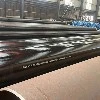
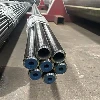
2205 Stainless Steel: A Duplex Grade with Double the Strength
2205 stainless steel is a duplex stainless steel - a two-phase material with a balanced austenite-ferrite microstructure - standardized as UNS S32205 under ASTM A240/A240M. It is composed of about 22% chromium, 4.5-6.5% nickel and 3.0-3.5% molybdenum with a nitrogen addition. Because of its mixed microstructure, 2205 delivers roughly twice the yield strength of ordinary austenitic grades while keeping excellent toughness and corrosion resistance.
1. Chemical Composition (UNS S32205)
| Element | Limit (%) |
|---|---|
| Carbon (C) | 0.030 max |
| Manganese (Mn) | 2.00 max |
| Silicon (Si) | 1.00 max |
| Phosphorus (P) | 0.030 max |
| Sulfur (S) | 0.020 max |
| Chromium (Cr) | 22.0 - 23.0 |
| Nickel (Ni) | 4.5 - 6.5 |
| Molybdenum (Mo) | 3.0 - 3.5 |
| Nitrogen (N) | 0.14 - 0.20 |
The ferrite formers (chromium, molybdenum) and austenite formers (nickel, nitrogen) are balanced so that the annealed structure contains roughly 40-50% ferrite and 50-60% austenite.
2. Strength: More Than Double Austenitic Steel
The yield strength of 2205 duplex stainless steel is more than double that of ordinary austenitic stainless steel - a minimum of about 450 MPa compared with roughly 205-215 MPa for 304 and 316L. This feature allows designers to reduce wall thickness and weight when designing products, making the alloy price-competitive with 316 and 317L on a strength-for-strength basis despite its higher unit cost.
3. Resistance to Stress Corrosion Cracking
2205 stainless steel has excellent resistance to stress corrosion cracking (SCC). Even the duplex stainless steels with the lowest alloy content have higher SCC resistance than austenitic stainless steel, especially in environments containing chloride ions - the classic failure mode for ordinary austenitic grades in hot chloride service. The duplex structure also gives good resistance to pitting and crevice corrosion, with a PREn of about 34.
4. Corrosion Performance and Applications
In many media the corrosion resistance of 2205 duplex stainless steel is better than that of ordinary 316L austenitic stainless steel, while super duplex grades such as 2507 offer even higher resistance. In some media, such as formic acid environments, 2205 can replace higher-alloy austenitic stainless steels and even some corrosion-resistant alloys. Typical applications include:
Oil and gas:
flowlines, process piping and subsea equipment exposed to chlorides and CO2
Chemical and petrochemical:
heat exchangers, pressure vessels and piping for aggressive media
Desalination and marine:
seawater cooling systems, pumps and valves
Pulp and paper:
digesters and bleach plant equipment
Frequently Asked Questions
What type of stainless steel is 2205?
It is a duplex stainless steel - a two-phase austenitic-ferritic grade - standardized as UNS S32205.
What is the composition of 2205?
Approximately 22% chromium, 4.5-6.5% nickel, 3.0-3.5% molybdenum and 0.14-0.20% nitrogen, with carbon limited to 0.030%.
Is 2205 stronger than 316L?
Yes. Its minimum yield strength of about 450 MPa is more than double the roughly 205-215 MPa of 304 and 316L.
Why is 2205 resistant to stress corrosion cracking?
The ferrite phase and the balanced duplex structure interrupt the crack path, so 2205 far outperforms austenitic grades in hot chloride environments.
What is the difference between 2205 and 2507?
2507 is a super duplex grade with more chromium and molybdenum, giving higher strength and corrosion resistance than 2205.
Can 2205 replace 316L in seawater service?
Yes, and it is usually preferred for seawater because of its superior pitting and SCC resistance and higher strength.