




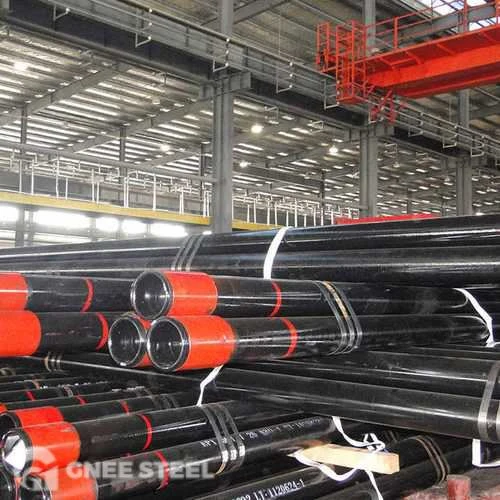


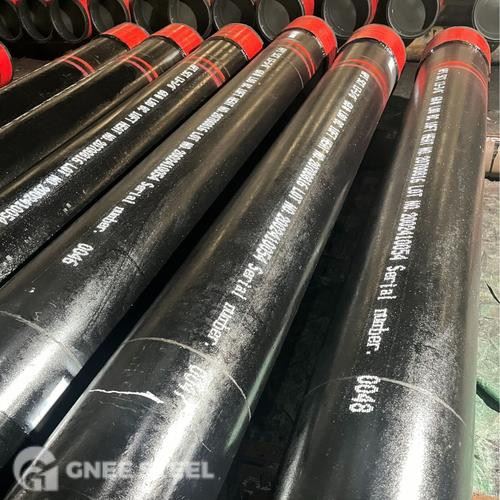
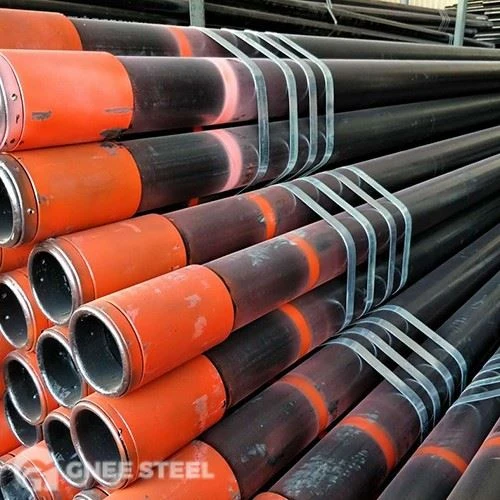
API 5CT K55 Casing Pipe
What is API 5CT K55 Casing Pipe?
Grade Level: Medium strength, general purpose.
Key Characteristic: It is the "workhorse" of the industry for shallow to medium-depth wells.
Comparison with J55: While both have a yield strength of 55,000 psi, K55 requires a minimum tensile strength of 95,000 psi, whereas J55 only requires 75,000 psi.
Color Code: K55 is identified by Two Bright Green Bands.
Click to inquire and receive the API certification report and application case studies for K55 casing-free of charge!
API 5CT K55 Specification Table
| Item | Details |
| Standard | API Spec 5CT / ISO 11960 |
| Steel Grade | K55 |
| Product Specification Level | PSL-1 (Standard), PSL-2, PSL-3 |
| Delivery Condition | As-rolled, Normalized, or Quenched & Tempered |
| Application | Production Tubing, Surface Casing, Intermediate Casing |
| Manufacturing Process | Seamless (S) or Electric Welded (EW) |
Chemical Composition & Mechanical Properties (K55)
Chemical Composition (%)
| Grade | Phosphorus (P) | Sulfur (S) | Carbon/Manganese |
| K55 | ≤ 0.030% | ≤ 0.030% | Manufacturer's choice (standard carbon steel) |
Mechanical Properties
| Property | Imperial Units | Metric Units |
| Yield Strength (Min - Max) | 55,000 – 80,000 psi | 379 – 552 MPa |
| Tensile Strength (Min) | 95,000 psi | 655 MPa |
| Elongation | Calculated based on specimen area | Calculated based on specimen area |
K55 Tubing Size Chart (Common Sizes)
| OD (inch) | OD (mm) | Weight (lb/ft) | Wall Thickness (mm) | End Connection |
| 2-3/8" | 60.3 | 4.60 | 4.83 | NU / EUE |
| 2-7/8" | 73.0 | 6.40 | 5.51 | NU / EUE |
| 3-1/2" | 88.9 | 9.20 | 6.45 | NU / EUE |
| 4-1/2" | 114.3 | 12.60 | 6.88 | NU / EUE |
API 5CT K55 Casing Dimensions and Connections (Common Sizes)
| Outer Diameter OD (inch) | Outer Diameter OD (mm) | Nominal Weight (lb/ft) | Wall Thickness (mm) | Common Connection Types |
| 4-1/2" | 114.30 | 9.50 - 11.60 | 5.21 - 6.35 | STC / LTC |
| 5-1/2" | 139.70 | 14.00 - 15.50 | 6.22 - 6.98 | STC / LTC |
| 7" | 177.80 | 20.00 - 23.00 | 6.91 - 8.05 | STC / LTC / BTC |
| 8-5/8" | 219.08 | 24.00 - 32.00 | 6.71 - 8.94 | STC / LTC / BTC |
| 9-5/8" | 244.48 | 36.00 - 40.00 | 7.92 - 8.94 | LTC / BTC |
| 10-3/4" | 273.05 | 40.50 - 45.50 | 8.89 - 10.16 | STC / BTC |
| 13-3/8" | 339.72 | 48.00 - 54.50 | 8.38 - 9.65 | BTC / STC |
| 20" | 508.00 | 94.00 - 133.00 | 11.13 - 16.13 | BTC |
Connections of API 5CT K55 Casing Pipe
K55 pipes are typically joined using standard API thread profiles:
STC (Short Thread Coupled): Used for shorter strings and lower tension environments.
LTC (Long Thread Coupled): The most common for K55, providing better tension capacity than STC.
BTC (Buttress Thread Coupled): A trapezoidal thread that offers superior resistance to pulling out; used for long, heavy casing strings.
NU/EU: Specifically for tubing (Non-upset and External Upset).
K55 Casing and Tubing Manufacturing Types
| Type | Description |
| Seamless (S) | Manufactured by piercing a solid billet; preferred for high-pressure integrity. |
| Electric Welded (EW) | Formed from a steel strip and welded longitudinally; generally more cost-effective. |
Reference Inspection for K55
To ensure compliance with API 5CT, K55 undergoes several mandatory inspections:
Hydrostatic Test: Every joint is tested with water at high pressure to ensure leak resistance.
Visual Inspection: Checking for surface flaws, scale, or pitting.
Dimensional Inspection: Verification of Outside Diameter (OD), Wall Thickness, and Length.
Drift Test: Ensuring a mandrel can pass through to verify internal clearance.
NDT (Non-Destructive Testing): Usually Ultrasonic (UT) or Electromagnetic (EMI) to find internal cracks or defects.
Flattening Test: Performed on Electric Welded (EW) pipes to ensure the weld seam is robust.
API 5CT K55 OCTG Test equipments

API 5CT K55 casing and tubing factory

API 5CT K55 Oil well casing certificate

FAQ
Is K55 carbon steel?
Yes, K55 is a carbon steel; it is a medium-to-high-strength carbon-manganese steel used for oil casing and tubing, classified under the API 5CT standard.
What is the difference between K55 and J55?
K55 and J55 are two grades of medium-strength carbon steel casing and tubing defined under the API 5CT standard. Their primary differences lie in their mechanical properties, compressive strength, and suitability for specific well conditions.
- Yield Strength: Both grades share a minimum yield strength of 379 MPa (55,000 psi); however, K55 is subject to stricter property controls, resulting in more stable actual performance.
- Tensile Strength: The minimum tensile strength for J55 is ≥ 517 MPa, whereas K55 is higher at ≥ 655 MPa; consequently, K55 possesses superior tensile and collapse resistance capabilities.
- Elongation: The minimum elongation for J55 is 19%, compared to 15% for K55. This indicates that J55 exhibits slightly better ductility, making it suitable for applications requiring bending or forming.
- Chemical Composition: The chemical compositions are fundamentally similar; however, K55 features a higher manganese content (1.25–1.50% compared to J55's 0.85–1.00%). Additionally, some K55 variants incorporate micro-alloying elements-such as vanadium (V)-to further enhance strength and toughness.
- Applications: J55 is a cost-effective option suitable for shallow wells and low-pressure environments. K55 is designed for slightly deeper wells or conditions involving higher pressures, offering enhanced safety margins, albeit at a slightly higher cost.
- Interchangeability: K55 can be used as a substitute for J55; however, J55 cannot be utilized in high-stress applications that were originally engineered to require K55.
Hot Tags: api 5ct k55 casing pipe, China api 5ct k55 casing pipe manufacturers, suppliers, factory, octg logistics, octg manufacturers, octg documentation, octg import, octg torque, octg feasibility studies
You Might Also Like


Send Inquiry