


NPT threads and Buttress threads are two distinct industrial connection standards designed for entirely different purposes. NPT is the standard for general industrial piping, while Buttress is a high-performance mechanical thread used for heavy-duty applications like oilfield casing.
Need high-tension reliability? Request the mechanical load limits for our API BTC (Buttress) casing to ensure downhole safety.
NPT Thread (National Pipe Taper)
NPT is the most common American standard for pipe threads, primarily designed for sealing.
Geometry: Features a symmetrical V-shape with a 60-degree included angle. The thread is tapered, meaning the diameter narrows toward the end of the pipe.
Sealing Principle: It relies on an "interference fit" to create a seal. As the male thread is screwed into the female thread, the taper causes them to compress against each other, cutting off leak paths. It usually requires a sealant like Teflon tape or pipe dope.
Advantages: Simple design and excellent sealing performance for various pressure environments.
Applications:
General industrial and residential plumbing.
Instrumentation, valves, and compressed air systems.
Liquid and gas transport systems where massive axial tension is not a factor.
Buttress Thread (Sawtooth/Trapezoidal Thread)
In the oil and gas industry, the Buttress thread under the API 5CT standard is known as BTC (Buttress Threaded and Coupled). Its primary design objective is mechanical strength.
Geometry: Features an asymmetrical trapezoidal (sawtooth) profile. The "load flank" (the side that takes the pressure) is nearly vertical (typically 3 degrees), while the other side is slanted.
Design Principle: This asymmetrical design is engineered to withstand extreme axial tension. The vertical load flank prevents the threads from "pulling out" or slipping under massive weight, allowing the joint strength to nearly match the strength of the pipe body.
Advantages: Extremely high tensile strength and collapse resistance, capable of supporting miles of steel pipe weighing hundreds of tons.
Applications:
Oil & Gas Casing (OCTG): Used to support heavy pipe strings in deep wells.
Heavy Machinery: Such as large screw presses, heavy-duty jacks, and artillery recoil mechanisms.
NPT (National Pipe Taper) threads and Buttress threads are designed for completely different purposes. While NPT is the standard for general industrial plumbing, Buttress is a high-performance mechanical thread used in heavy-duty applications like oilfield casing.
Thread Profile (Shape)
NPT Thread: Features a V-shape with a 60-degree included angle. The crests and roots are slightly flattened (truncated). It is a symmetrical thread.
Buttress Thread: Features a Trapezoidal (sawtooth) shape. One side of the thread (the load flank) is nearly vertical (3 to 7 degrees), while the other side is slanted (usually 10 to 45 degrees). This allows it to handle immense force in one direction.
Primary Function
NPT Thread: Designed primarily for sealing. It is a tapered thread where the seal is created by the "interference fit" between the male and female threads, usually requiring a sealant like Teflon tape or pipe dope.
Buttress Thread: Designed primarily for load-bearing and tensile strength. In the oilfield (API BTC), it is used to support the weight of miles of pipe hanging in a well. It can handle massive "pull-out" forces that would easily strip an NPT thread.
Application
NPT: Used in low-to-medium pressure industrial piping, household plumbing, air compressors, and instrumentation.
Buttress: Used in Oil and Gas Casing (OCTG), heavy-duty mechanical jacks, and artillery recoil mechanisms. It is the go-to thread when a pipe string is extremely heavy or under high axial tension.
Comparison Table
| Feature | NPT Thread | Buttress (BTC) Thread |
| Shape | Symmetrical "V" Shape | Asymmetrical Trapezoidal |
| Standard | ASME/ANSI B1.20.1 | API 5B / 5CT |
| Seal Type | Interference (Metal-to-Metal + Dope) | Interference (Mechanical Lock + Dope) |
| Tensile Strength | Low | Extremely High |
| Sealing Goal | Liquid/Gas Leak Prevention | Mechanical Integrity + Leak Prevention |
| Common Use | Pipes, Valves, Fittings | Casing and Heavy Machinery |
GNEE Buttress Threads Process Line

GNEE API 5CT Buttress Threads Test Equipments

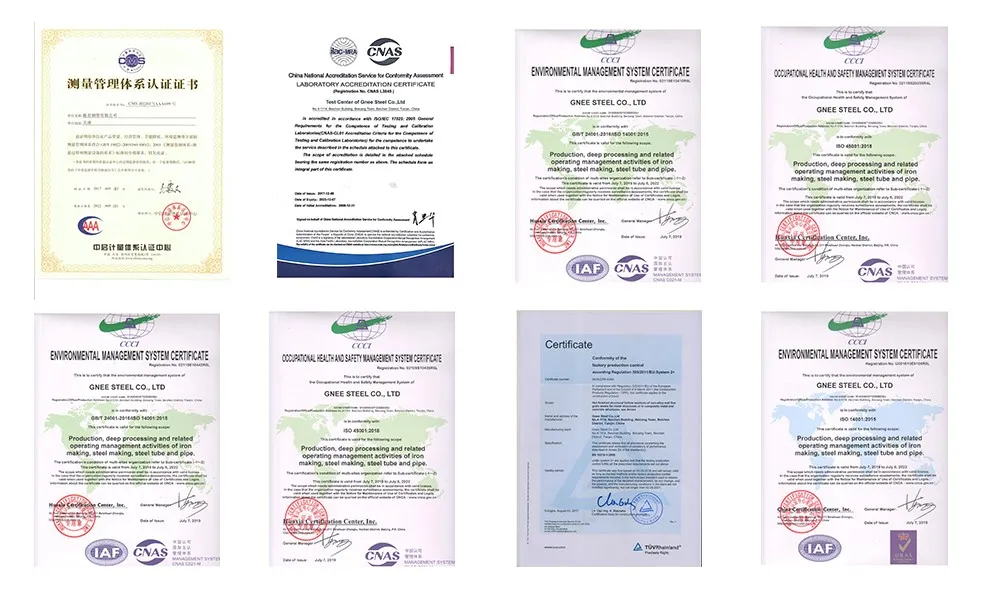
GNEE OCTG Buttress Thread Certificate
FAQ
How do you know if a thread is BSP or NPT?
Determining the difference between BSP (British Standard Pipe) and NPT (National Pipe Taper) is crucial because they are not compatible. Here is how to tell them apart:
1. Check the Thread Angle
NPT: Has a 60° included angle (the peaks/valleys are sharper).
BSP: Has a 55° included angle (the peaks/valleys are more rounded).
2. Measure the Pitch (Threads Per Inch - TPI)
Use a thread pitch gauge. Even if the diameters are similar, the pitch often differs:
Example (1/2" size): NPT is 14 TPI, while BSP is 14 TPI (They match here, but the angle differs!).
Example (1" size): NPT is 11.5 TPI, while BSP is 11 TPI.
3. Check for Taper vs. Parallel
NPT: Always tapered (the pipe gets narrower at the end).
BSP: Can be tapered (BSPT) or parallel (BSPP). If the thread is perfectly straight (like a bolt), it is almost certainly BSPP.
4. Origin of the Equipment
NPT: Common in the USA, Canada, and Mexico.
BSP: Standard in the UK, Europe, Australia, New Zealand, and most of Asia.
What are the advantages of buttress thread?
The Buttress (BTC) thread is designed for maximum mechanical performance. Its main advantages include:
Extreme Tensile Strength: Its trapezoidal (asymmetrical) shape provides superior "pull-out" resistance, allowing the connection to support the massive weight of miles of pipe.
Excellent Joint Integrity: The joint strength is nearly equal to the strength of the pipe body itself, making it reliable for deep and heavy casing strings.
High Torque Resistance: It can handle more twisting force during installation or rotation compared to standard round threads (STC/LTC).
Compression & Bending Stability: It performs better in deviated or horizontal wells where the pipe might experience significant bending or crushing forces.
Durability: The thicker, flatter threads are less likely to be damaged (cross-threaded) during field handling compared to sharper V-threads.


