


API Casing refers to large-diameter steel pipes compliant with the API 5CT standard, which are permanently cemented into a borehole to provide structural integrity, isolate fluid layers, and protect groundwater.
These pipes range in size from 4-1/2" to 20" in outside diameter (OD) and are available in three standard length categories, with Range 2 (25–34 ft) being the industry standard. Selecting the right casing requires balancing the outside diameter, wall thickness (nominal weight), steel grade, and thread connection to ensure the pipe string can withstand the specific mechanical loads and environmental conditions of the well.
The following is a comprehensive API 5CT Casing Size and Parameter Chart organized according to the API Spec 5CT standard. This table covers the core data critical for procurement and engineering: Outside Diameter (OD), Nominal Weight, Wall Thickness, Inside Diameter (ID), and Drift Diameter.
API 5CT Casing Size and Specification Table (Common Sizes)
| Outside Diameter (OD) - inch | OD (mm) | Nominal Weight (lb/ft) | Wall Thickness (mm) | Inside Diameter (ID) - mm | Drift Diameter (mm) | Common Usage |
| 4-1/2" | 114.30 | 9.50 | 5.21 | 103.88 | 100.31 | Production Casing / Liner |
| 11.60 | 6.35 | 101.60 | 98.02 | |||
| 13.50 | 7.37 | 99.56 | 95.98 | |||
| 5-1/2" | 139.70 | 14.00 | 6.22 | 127.26 | 124.08 | Most common Production Casing |
| 15.50 | 6.98 | 125.74 | 122.56 | |||
| 17.00 | 7.72 | 124.26 | 121.08 | |||
| 20.00 | 9.17 | 121.36 | 118.18 | |||
| 23.00 | 10.59 | 118.52 | 115.34 | |||
| 7" | 177.80 | 20.00 | 6.91 | 163.98 | 160.80 | Intermediate / Production Casing |
| 23.00 | 8.05 | 161.70 | 158.52 | |||
| 26.00 | 9.19 | 159.42 | 156.24 | |||
| 29.00 | 10.36 | 157.08 | 153.90 | |||
| 32.00 | 11.51 | 154.78 | 151.60 | |||
| 9-5/8" | 244.48 | 36.00 | 8.94 | 226.60 | 222.63 | Most common Intermediate Casing |
| 40.00 | 10.03 | 224.42 | 220.45 | |||
| 43.50 | 11.05 | 222.38 | 218.41 | |||
| 47.00 | 11.99 | 220.50 | 216.53 | |||
| 53.50 | 13.84 | 216.80 | 212.83 | |||
| 10-3/4" | 273.05 | 40.50 | 8.89 | 255.27 | 251.30 | Intermediate Casing |
| 45.50 | 10.16 | 252.73 | 248.76 | |||
| 13-3/8" | 339.72 | 48.00 | 8.38 | 322.96 | 319.39 | Surface Casing |
| 54.50 | 9.65 | 320.42 | 316.85 | |||
| 61.00 | 10.92 | 317.88 | 314.31 | |||
| 68.00 | 12.19 | 315.34 | 311.77 | |||
| 20" | 508.00 | 94.00 | 11.13 | 485.74 | 482.17 | Conductor / Surface Casing |
| 106.50 | 12.70 | 482.60 | 479.03 | |||
| 133.00 | 16.13 | 475.74 | 472.17 |
Length Ranges (Range)
API 5CT divides casing lengths into three categories. The range must be specified during procurement:
Range 1: 4.88 to 7.62 meters (16.0 to 25.0 ft)
Range 2: 7.62 to 10.36 meters (25.0 to 34.0 ft) -- Most Common
Range 3: 10.36 to 14.63 meters (34.0 to 48.0 ft) -- Preferred for Deep Wells
Drift Diameter
Definition: The maximum diameter of a standard cylindrical mandrel that can pass freely through the casing's interior.
Importance: It determines the maximum size of subsequent drill bits or downhole tools (such as tubing or packers). When designing a well structure, engineers must refer to the Drift Diameter, not just the ID.
Steel Grades
Common grades include:
Low-End: J55 / K55
Mid-Range: N80-1 / N80-Q
Sour Service (H2S Resistant): L80 / C90 / T95
High Strength: P110 / Q125
GNEE OCTG Casing Pipe process line
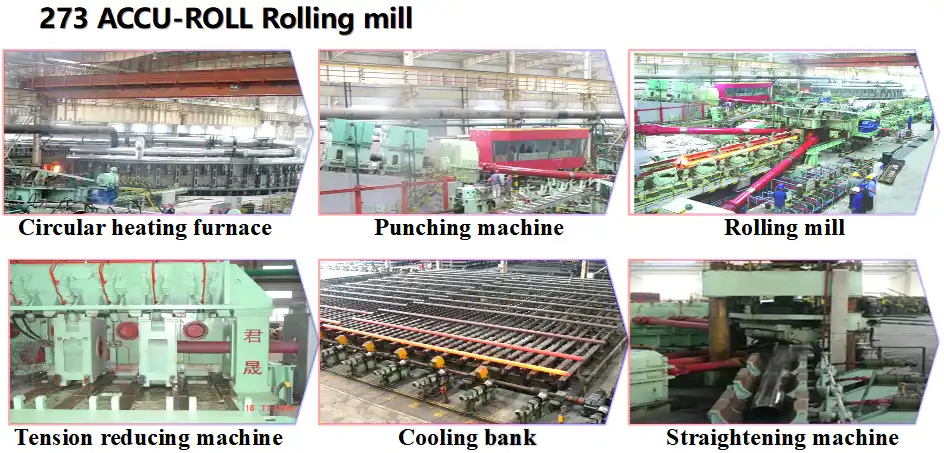
GNEE API Casing Pipe test equipments

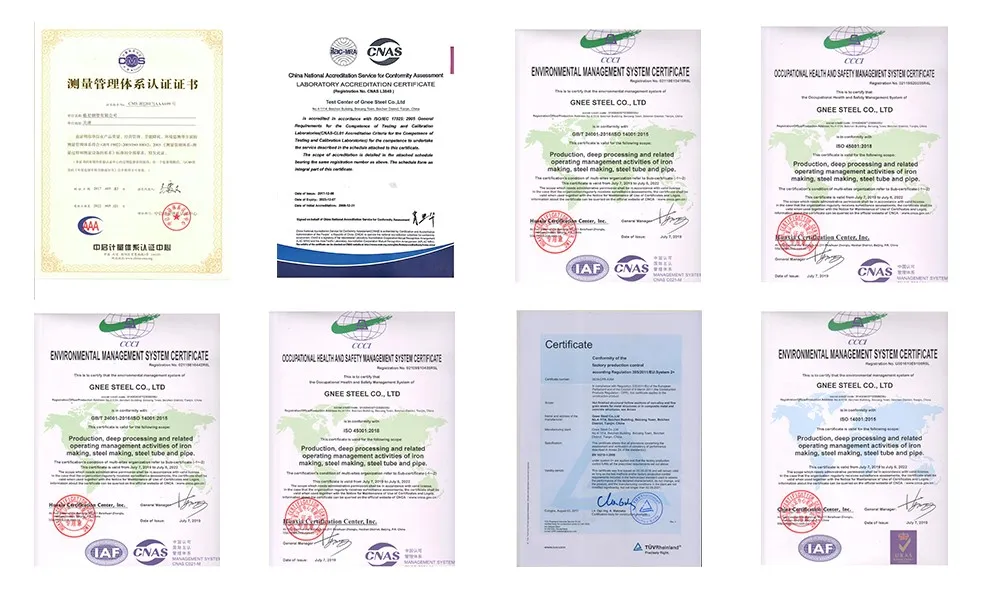
GNEE Oil Wel Casing Pipe certificate
FAQ
How to determine casing size?
Determining casing size is a "bottom-to-top" telescoping design process. Engineers follow these key steps:
Start with the End Goal: The size of the production equipment (tubing, pumps, or final drill bit) determines the diameter of the innermost pipe (Production Casing).
Account for Clearance: Each casing string must be large enough to allow the next drill bit to pass through while leaving enough space (annulus) for cementing.
Work Upward (The Telescoping Rule): You calculate outward to determine the size of the larger outer strings. For example, a common design is: 5-1/2" (Production) → 9-5/8" (Intermediate) → 13-3/8" (Surface).
Consider Geology: Deeper wells or those with high-pressure "trouble zones" may require extra intermediate strings, which forces the starting surface casing to be much larger (e.g., starting with 20" instead of 13-3/8").
What is normal casing?
"Normal casing" refers to standard API 5CT casing used in conventional wells where extreme corrosion ( H2S ) or ultra-high pressures are not present. It follows the industry's most common "off-the-shelf" specifications:
Common Grades: J55, K55, or N80-1. These provide sufficient strength for shallow to medium-depth wells at the lowest cost.
Standard Length: Range 2 (25–34 feet), which is the global benchmark for transport and rig handling.
Standard Threads: API LTC (Long Round) or API BTC (Buttress) connections.
Standard Sizes: Typical diameters like 9-5/8" (Intermediate) or 5-1/2" (Production).
What are the types of casings?
Casing is categorized in three ways to ensure wellbore integrity:
By Function (The Strings):
Conductor: The first, largest string to prevent surface cave-ins.
Surface: Protects freshwater aquifers and supports the blowout preventer (BOP).
Intermediate: Isolates high-pressure or unstable zones at mid-depth.
Production: The final string through which oil or gas is extracted.
Liner: A string that does not reach the surface, used to save costs.
By Material Grade (API 5CT):
General Purpose: J55, K55, N80.
Sour Service (Anti-Corrosion): L80, C90, T95 (used for
H2SH2S
environments).
High Strength: P110, Q125 (used for ultra-deep wells).
By Connection (The Threads):
API Standard: STC (Short), LTC (Long), BTC (Buttress).
Premium Connections: Proprietary gas-tight threads for extreme pressures.


