


Choosing the right API 5CT Casing is a critical decision that impacts the safety, lifespan, and cost-efficiency of an oil well. A mistake in material selection can lead to catastrophic failures like blowouts, collapsed pipes, or environmental leaks.
Identify the Steel Grade (Strength & Environment)
API 5CT grades are classified based on their yield strength and resistance to corrosive chemicals.
For Shallow, Low-Pressure Wells: Use J55 or K55. These are the most economical "standard" grades.
For Deep, High-Pressure Wells: Use P110 or Q125. These high-strength grades can support the massive weight of long casing strings and resist high formation pressures.
For Sour Service ( H2S Environments): Use L80, C90, or T95. These have controlled hardness (e.g., L80 is max 23 HRC) to prevent Sulfide Stress Cracking (SSC). Warning: Never use standard P110 in a sour well.
For CO2 Corrosion: Use L80-13Cr. The high chromium content prevents the "pitting" corrosion caused by carbon dioxide.
Determine the Outside Diameter (OD) & Wall Thickness
Casing design follows a "telescoping" approach (larger at the top, smaller at the bottom).
Size (OD): Common sizes range from 4-1/2" to 20". Your selection depends on the hole size drilled and the size of the tools (bits/tubing) that must pass through it later.
Weight (Wall Thickness): Heavier weights (lb/ft) have thicker walls. You need heavier pipe for:
High Collapse Pressure: If the earth/salt layers are squeezing the pipe.
High Burst Pressure: If the internal gas/oil pressure is extremely high.
Select the Right Connection (Thread Type)
The connection is often the "weakest link" in a well. You must match the connection to the well's mechanical demands.
API LTC (Long Round): The standard for vertical oil wells. It offers good liquid sealing and moderate strength.
API BTC (Buttress): Use this for heavy casing strings or deep wells. The trapezoidal threads provide excellent tensile strength to prevent the pipe from pulling apart.
Premium Connections: If you are drilling a High-Pressure Gas Well or a horizontal well, API threads are not enough. You need Premium threads (e.g., VAM® or TenarisHydril) that offer a metal-to-metal gas-tight seal.
Verify the Drift Diameter
The Drift Diameter is the guaranteed internal clearance of the pipe.
Crucial Step: You must ensure that the "Drift" of your casing is larger than the "Outside Diameter" of the next drill bit or the production tubing you plan to install later. If you buy a heavy-wall casing without checking the drift, your tools may get stuck.
Choose the Length Range & PSL Level
Length (Range 2 vs. Range 3): Range 2 (25–34 ft) is the global standard. Range 3 (34–48 ft) is used for deep or offshore wells to reduce the number of connections and save time, but check if your rig can handle the extra height.
Quality (PSL-1 vs. PSL-2): For offshore, high-pressure, or critical wells, always request PSL-2. It requires stricter chemical tolerances and mandatory impact testing (Charpy V-notch) compared to the basic PSL-1.
GNEE API Casing Pipe process line

GNEE OCTG Casing Pipe test equipments

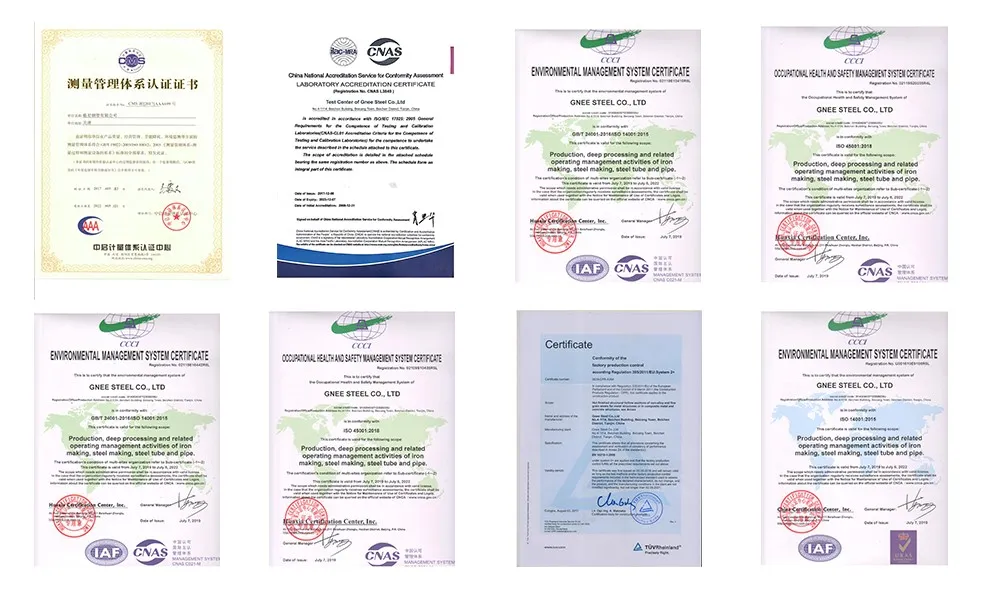
GNEE Oil Well Casing certificate
FAQ
How to determine well casing size?
Determining casing size is a "bottom-to-top" telescoping design process. Engineers follow these key steps:
Start with the End Goal: The size of your final production equipment (like tubing or pumps) dictates the diameter of the innermost pipe (Production Casing).
Account for Clearance: Each outer casing string must be large enough to allow the next drill bit to pass through its interior while leaving enough space (annulus) on the outside for cementing.
Work Upward: You calculate outward to determine the size of the larger outer strings. A common progression is: 5-1/2" (Production) → 9-5/8" (Intermediate) → 13-3/8" (Surface).
Consider Geology: Deeper wells or those with high-pressure "trouble zones" require extra intermediate strings, which forces the starting surface casing to be even larger (e.g., starting with 20").
What is the range of API 5CT?
In API 5CT, the term "Range" specifically refers to the length of a single joint of pipe. There are three standard length ranges:
Range 1: 16.0 – 25.0 ft (4.88 – 7.62 m) - Shortest.
Range 2: 25.0 – 34.0 ft (7.62 – 10.36 m) - Industry Standard / Most Common.
Range 3: 34.0 – 48.0 ft (10.36 – 14.63 m) - Used for deep or offshore wells.


