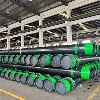
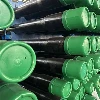
13-3/8 Surface Casing: What the String Does in the Well
The string is set from surface through the shallowest formations, normally somewhere between a few hundred meters and about 2,500 ft depending on the aquifer depth and the local drilling rule. Its job is narrow and non-negotiable: isolate the freshwater zones from everything drilled below, give the blowout preventer a flange to sit on, and carry the weight of the strings that follow. It is cemented back to surface, so the pipe is supported along its whole length rather than hanging from the wellhead, which is why a surface string rarely needs a high grade. J55 and K55 cover most of this work; N80 appears where the shoe is set deeper or the formation is lost-circulation prone.
13-3/8 surface casing also sets the hole size below it. A 12-1/4 in. bit is the standard follow-on, and the drift of the string decides whether that bit and the tools behind it can pass. On 339.7 mm casing the drift falls from 318.99 mm at 48.00 lb/ft to 309.63 mm at 72.00 lb/ft, so weight selection is not a strength question alone: it decides the bore the next hole has to fit through.
13-3/8 Casing Weight Per Foot: 48, 54.5, 61, 68 and 72 lb/ft
13-3/8 casing weight runs from 48.00 to 72.00 lb/ft in five standard steps, and the step chosen is the one decision that changes every dimension below the surface. Nominal weight is the mass of one foot of plain-end pipe at nominal OD and nominal wall, coupling and thread excluded. All five weights share the 339.72 mm body, so every step up in weight buys wall thickness and collapse resistance and pays for it with bore. The spread across the range is 27.9 mm of inside diameter, which is more than enough to change what a packer or a drilling assembly can do.
Table 2 - 13-3/8 in. (339.7 mm) casing: engineering data per weight
| lb/ft | Wall (in) | Wall (mm) | ID (mm) | Drift (mm) | kg/m | Body yield at 379 MPa (kip) | Per 12 m joint (t) |
|---|---|---|---|---|---|---|---|
| 48.00 | 0.330 | 8.38 | 322.96 | 318.99 | 71.43 | 743 | 0.86 |
| 54.50 | 0.380 | 9.65 | 320.42 | 316.45 | 81.10 | 853 | 0.97 |
| 61.00 | 0.430 | 10.92 | 317.88 | 313.91 | 90.78 | 961 | 1.09 |
| 68.00 | 0.480 | 12.19 | 315.34 | 311.37 | 101.19 | 1069 | 1.21 |
| 72.00 | 0.514 | 13.06 | 313.60 | 309.63 | 107.15 | 1142 | 1.29 |
OD 339.72 mm (13.375 in). Wall, ID and drift are API 5CT / API RP 5A5 values; body yield is calculated as steel area x 379 MPa (K55 minimum yield) for comparison, and scales with the grade actually ordered. Joint tonnage is nominal weight x 39.37 ft, coupling excluded.
Two weights carry most of the market. The 68.00 lb/ft wall is the standard surface weight in US land work, and 54.50 lb/ft is the light option where the shoe is shallow and the rig is weight-limited. The 48.00 lb/ft wall exists mainly in J55 and K55 and is the cheapest way to get 339.7 mm of hole protection; the 72.00 lb/ft wall is rolled in the higher grades rather than in J55, because a buyer paying for that much steel is usually chasing collapse resistance, not price.
13-3/8 in., 68 lb/ft casing pipe: The Standard Surface Weight
The 13-3/8 in., 68 lb/ft casing pipe is the default for a reason that has nothing to do with strength: it is the heaviest standard weight whose drift still clears a 12-1/4 in. bit. At 12.19 mm wall the drift is 311.37 mm, and a 12-1/4 in. (311.15 mm) bit needs 311.15 mm, so the clearance is 0.22 mm on paper and effectively zero on a rig floor. Going to 72.00 lb/ft drops the drift to 309.63 mm and the bit no longer passes at all. That is why 72 lb/ft is a collapse-driven choice for a short, high-pressure surface section, and why a program that specifies it has already re-planned the hole below.
13-3/8 Casing Dimensions: Inside Diameter and Drift Diameter
The dimensions that decide whether the string works are the inside diameter and the drift, and they are not the same number. The inside diameter is arithmetic: nominal OD less twice the nominal wall. The drift is the diameter of the mandrel that must pass the full length of every joint, and it is the only one of the two that carries a physical test. On this size the drift sits about 3.97 mm (0.156 in) under the calculated inside diameter.
Table 1 - Inside diameter and drift of 13-3/8 in. (339.7 mm) casing, by weight
| lb/ft | Wall (in) | Drift (mm) | Drift (in) | Capacity (bbl/ft) | D/t |
|---|---|---|---|---|---|
| 48.00 | 0.330 | 318.99 | 12.559 | 0.1571 | 40.5 |
| 54.50 | 0.380 | 316.45 | 12.459 | 0.1546 | 35.2 |
| 61.00 | 0.430 | 313.91 | 12.359 | 0.1522 | 31.1 |
| 68.00 | 0.480 | 311.37 | 12.259 | 0.1497 | 27.9 |
| 72.00 | 0.514 | 309.63 | 12.191 | 0.1481 | 26.0 |
Capacity = ID squared / 1029.4 in bbl/ft, calculated from the nominal inside diameter. D/t is nominal OD over nominal wall. Drift values are the API 5CT drifting mandrel diameters; the 72.00 lb/ft weight also has an alternative drift under API 5CT for special applications, which must be named on the order if it is wanted.
A completion or drilling tool sized to the inside diameter will eventually stop in a joint that passed inspection, because wall thickness may run 12.5 % under nominal and the drift already accounts for that. Size to the drift, and treat any margin under about 3 mm as a question for the tool vendor rather than a comfortable clearance. The casing drift diameter is a guaranteed bore, not a nominal one, and that distinction is the whole reason the mandrel test exists.
13-3/8 Casing Coupling Specifications
A 13-3/8 casing coupling is 365.12 mm (14.375 in) outside diameter, which is 25.4 mm larger than the pipe body and makes the connection the widest part of the string. That matters in a tight surface hole and in the elevator, and it is why coupling outside diameter is a line on the data sheet rather than an assumption. The length and mass depend entirely on the thread form.
Table 3 - Coupling dimensions for 339.72 mm casing (API 5B)
| End finish | Coupling OD (mm / in) | Coupling length (mm / in) | Coupling mass (kg / lb) | Thread | Ordered for |
|---|---|---|---|---|---|
| STC | 365.12 / 14.375 | 203.20 / 8.000 | 25.4 / 56.2 | 8 round, 8 threads/in, 60° | Standard and light surface strings |
| BTC | 365.12 / 14.375 | 269.88 / 10.625 | 31.8 / 70.0 | Buttress, 5 threads/in, 3° load flank | Deep shoes, high tension, gas service |
| LTC | not offered | not offered | not offered | long round | Not available above 10-3/4 in. under API 5B |
Coupling values from API 5B round-thread and buttress tables. The 13-3/8 size has no standard long round thread coupling, so a specification that calls for LTC on this size cannot be filled as written. Special-clearance and premium connections are separate products with their own drawings.
Two consequences follow. First, a 13-3/8 casing coupling adds about 25.4 mm to the string diameter at every joint, so a hole that is already tight to the pipe will be tighter at the couplings. Second, the BTC coupling is 66.7 mm longer and 6.4 kg heavier than the STC version, and that mass sits at every connection: on a 300-joint string the difference is close to two tonnes of hook load that buys nothing except thread strength.
Connection Types and Thread Forms
Only two standard connections apply to this size, and they are not interchangeable in either direction.
The STC thread is an 8-round form at 8 threads per inch with a 60° included angle, cut on a taper. It is the cheapest connection made, it is fast to run, and it seals on thread interference plus thread compound rather than on a metal-to-metal flank. That is adequate for a cemented surface string, which sees little internal pressure and is supported along its length. STC develops roughly 60 to 80 % of pipe-body tensile strength, so it is not the connection to specify where the string will hang free.
The BTC casing connection is a buttress form with a 3° load flank, 5 threads per inch and a 1:16 taper. The near-vertical load flank carries tension far better than the round form, and the stabbing flank is steep enough to guide make-up without cross-threading. It reaches close to pipe-body strength and is the default where the surface string is long, where the well is gassy, or where the operator wants one connection standard across the well. It is not a gas-tight seal in the premium sense: it still relies on compound, and for gas lift or high-pressure gas a premium connection with a metal-to-metal seal is the correct choice.
Is your specification asking for LTC on this size?
There is no standard API long round thread above 10-3/4 in., so the choice here is STC against BTC and it is cheaper to settle it before the inquiry leaves than after the offer comes back. Send the weight, the grade and the end finish you intend to run, and the comparison sheet comes back with both couplings side by side: drawing reference, make-up length, coupling mass and the drift for that string, in a form that can be attached to a technical bid.
Get the STC / BTC comparison sheet
Steel Grades and Material Properties
API 5CT casing grades are fixed by minimum yield strength, but on a surface string the deciding question is usually cost and weldability rather than strength. The practical range for 13-3/8 runs from J55 through P110, with Q125 available in the two heavy walls where a short section has to hold a high collapse load.
Table 4 - Mechanical requirements by grade (API 5CT)
| Grade | Yield min (MPa) | Yield max (MPa) | Tensile min (MPa) | Hardness max | Typical use here |
|---|---|---|---|---|---|
| J55 | 379 | 552 | 517 | Not specified | Standard surface string, lowest cost |
| K55 | 379 | 552 | 655 | Not specified | Same yield, higher tensile for coupling strength |
| N80-1 / N80Q | 552 | 758 | 689 | Not specified | Deeper shoe, lost-circulation zones |
| L80-1 | 552 | 655 | 655 | 23 HRC | Sour surface sections, hardness controlled |
| C90-1 | 621 | 724 | 689 | 25.4 HRC | Sour service with higher load |
| T95-1 | 655 | 758 | 724 | 25.4 HRC | Sour service, heavy wall |
| P110 | 758 | 965 | 862 | Not specified | High collapse in the 68 and 72 lb/ft walls |
| Q125-1 | 862 | 1,034 | 931 | Not specified | Short high-pressure section, special order |
API 5CT values in SI units. Hardness limits apply to the sour-service grades only; a grade without a hardness ceiling is not qualified for H2S service merely because it is strong.
Grades for Sweet Service
J55 and K55 share the same 379 MPa minimum yield and differ only in tensile strength: K55 is held to 655 MPa against 517 MPa, which is what the coupling thread is designed around. For a cemented surface string either will do, and J55 is the cheaper of the two. Where the shoe goes deeper or the formation takes fluid, N80 casing adds 173 MPa of yield in the same wall, and the type suffix matters: N80-1 is normalized, N80Q is quenched and tempered, and the two are not interchangeable on a purchase order even though the strength band is identical.
Grades for Sour Service
If the shallow section contains hydrogen sulfide at a partial pressure that engages NACE MR0175 / ISO 15156, strength stops being the criterion and hardness becomes it. L80-1 at 23 HRC is the entry grade, C90 and T95 at 25.4 HRC cover higher loads, and no J55, K55, N80 or P110 joint qualifies however thick its wall. Sour surface sections are uncommon but not rare in fields with shallow sour gas, and a supplier who offers N80 for that service has misread the requirement.
Table 5 - Chemical requirements, maximum unless a range is given (%)
| Grade | C | Mn | Mo | Cr | Ni | P | S |
|---|---|---|---|---|---|---|---|
| J55, K55, N80-1, N80Q | NL | NL | NL | NL | NL | 0.030 | 0.030 |
| L80-1 | 0.43 | 1.90 | NL | NL | 0.25 | 0.030 | 0.030 |
| C90-1 | 0.35 | 1.20 | 0.25-0.85 | NL | 0.99 | 0.020 | 0.010 |
| T95-1 | 0.35 | 1.20 | 0.25-0.85 | 0.40-1.50 | 0.99 | 0.020 | 0.010 |
| P110 | NL | NL | NL | NL | NL | 0.030 * | 0.030 * |
| Q125-1 | 0.35 | 1.35 | 0.85 | 1.50 | 0.99 | 0.020 | 0.010 |
NL = no limit. * Electric-welded P110 is held to 0.020 % P and 0.010 % S. L80-1 also carries 0.45 % maximum silicon and 0.35 % maximum copper. Thin-wall and oil-quenched footnotes in API 5CT Table E.5 apply as written there.
Check the paper before the crane lift. A rejected 13-3/8 joint is a lift, a re-test and an argument about a heat number, and the certificate wording is the only thing that settles it. Ask for the certificate before the tonnage is fixed: which part of EN 10204 applies, whether the API monogram is stamped on the joint or only carried on the paperwork, which impact temperature PSL-2 is tested at, and whether the heat number on the sample is the one that will ship. Ask for a sample certificate for the grade you intend to order, and read it against the purchase order before the offer is signed.
Length Ranges
API 5CT defines three casing length ranges, and the choice changes the number of connections in the string rather than the pipe itself. Range 1 joints run 4.88 to 7.62 m, Range 2 runs 7.62 to 10.36 m and Range 3 runs 10.36 to 14.63 m. Within a range at least 95 % of the joints in a shipment must meet the minimum length, which is why a tally of "12 m casing" always contains a few shorter joints. Commercial practice has settled on Range 3 for most deliveries, and export orders commonly arrive at 12.8 to 13.4 m.
Table 6 - Length ranges, joint mass and shipping figures for 339.72 mm casing
| lb/ft | Range 3 length (m) | Joint mass at 12 m (t) | Joints per 100 t | 40 ft joint (t) | Truck load at 24 t |
|---|---|---|---|---|---|
| 48.00 | 10.36-14.63 | 0.86 | 117 | 0.87 | 27 |
| 54.50 | 10.36-14.63 | 0.97 | 103 | 0.99 | 24 |
| 61.00 | 10.36-14.63 | 1.09 | 92 | 1.11 | 21 |
| 68.00 | 10.36-14.63 | 1.21 | 82 | 1.23 | 19 |
| 72.00 | 10.36-14.63 | 1.29 | 78 | 1.31 | 18 |
Joint mass = nominal weight x length, plain end, coupling excluded. Truck and container figures are arithmetic on nominal weight and ignore packing and stacking losses; treat them as planning figures, not as a loading plan.
Length has a cost consequence that is easy to miss. A 12 m joint instead of a 7 m joint removes roughly 40 % of the connections from a string of the same total length, and every connection removed is one less make-up, one less thread inspection and one less place for a leak. The limit is the rig: a Range 3 joint needs a floor and a pipe rack that can handle it, and on small rigs the longer joint is simply not runnable.
Booking transport for a 300-joint string? The truck count follows from the weight, not from the meterage: a 12 m joint of 48.00 lb/ft is 0.86 t and the same length at 72.00 lb/ft is 1.29 t, so two strings of equal length can differ by half the fleet. Send the string length in meters and the weight you have settled on, and the joint count, tonnage and loads at 24 t come back line by line for each weight you are considering - work out the tonnage before the trucks are called.
How to Specify Casing on an RFQ
An RFQ that names these eight items comes back as a firm offer that can be compared line by line instead of a range that has to be re-quoted:
Nominal OD and weight written together, for example 13-3/8 in. x 68 lb/ft
Grade and type, with J55, K55, N80-1 or N80Q named rather than left open
PSL level, and the impact test temperature if PSL-2 applies
End finish, STC or BTC, since LTC is not available on this size
Length range R1, R2 or R3, and the acceptable spread inside it
Drift requirement, standard or the alternative drift
Certificate to EN 10204 3.1 or 3.2, plus API monogram if the buyer requires it
Quantity in joints or in meters, with the tonnage implied by the nominal weight
On arrival, check the joint and not the paperwork. Pass the drift mandrel over the full length, measure wall at four points on both ends, check coupling outside diameter at 365.12 mm and make-up length against API 5B, verify straightness, and match the stencil and heat number to the mill certificate. A 13-3/8 joint is heavy enough that a rejected one is a crane lift and a paperwork argument, so the check is cheaper than the discovery.
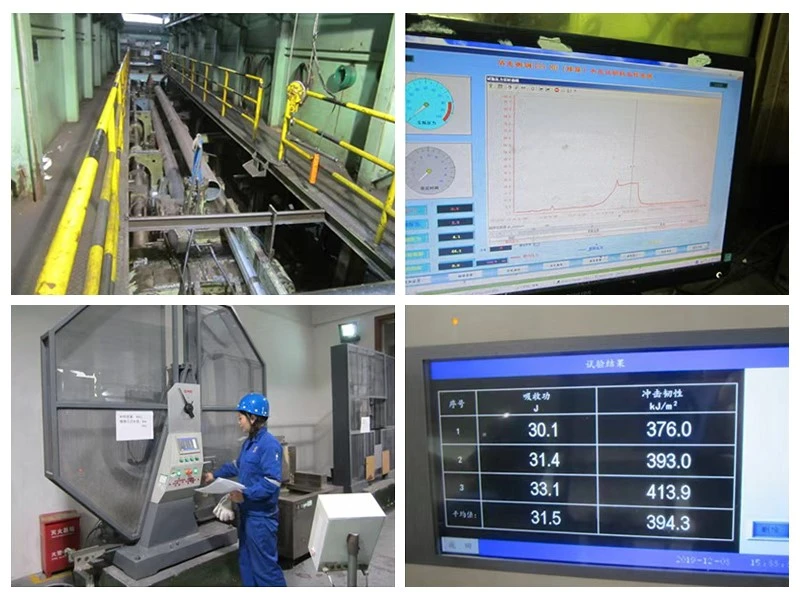
Surface casing test and inspection
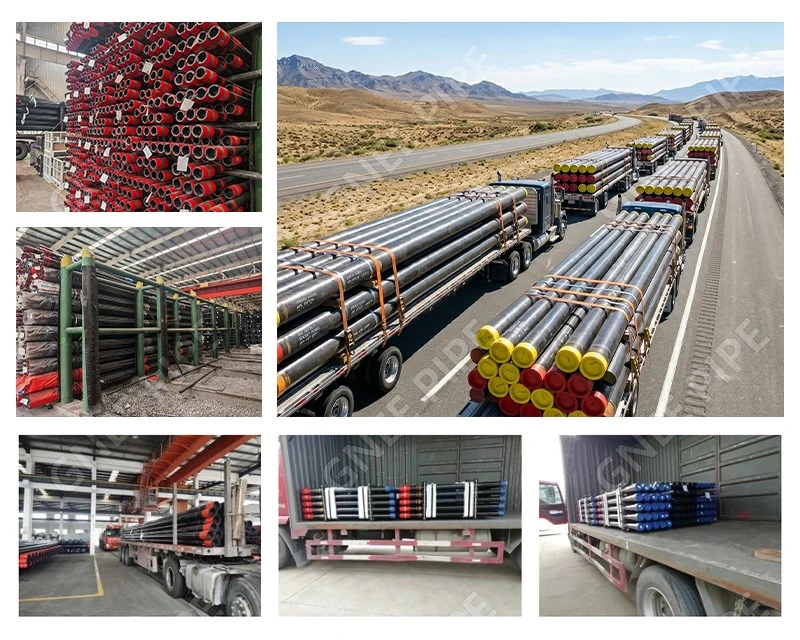
packaging and shipping
Send the eight lines and the tonnage is worked out for you.
Related Product
API 5CT Grade N80 Type Q Casing Steel Pipes
FAQ
What does 13-3/8 in. refer to on a casing data sheet?
It is the nominal outside diameter: 339.72 mm or 13.375 in exactly, rounded to 339.7 mm in metric catalogs. It is not a bore and not a thread size. The weight designation that follows it is what fixes wall thickness, inside diameter and drift, so two 13-3/8 joints of different weights are the same pipe on the outside and different pipe everywhere else.
Can 13-3/8 in. casing be supplied with LTC connections?
No, not as a standard API product. Long round thread couplings stop at 10-3/4 in., so this size is offered in STC and BTC only. An inquiry that asks for 13-3/8 LTC will come back either as a substitution proposal or as a special-order question, and it is better to decide between STC and BTC before the inquiry is sent.
How heavy is one joint of 13-3/8 in. casing?
Between about 0.86 and 1.29 tonnes at 12 m, depending on weight: 48 lb/ft gives 0.86 t, 54.5 gives 0.97 t, 61 gives 1.09 t, 68 gives 1.21 t and 72 gives 1.29 t, plain end and without the coupling. At 40 ft the same joints run 0.87 to 1.31 t. These are nominal figures; a joint may legally weigh 3.5 % less or 6.5 % more.
Which weight is standard for a 13-3/8 in. surface string?
68.00 lb/ft is the usual choice in US land work, and 54.50 lb/ft is the light alternative where the shoe is shallow. The reason 68 dominates is clearance rather than strength: its 311.37 mm drift still passes a 12-1/4 in. bit, while 72.00 lb/ft at 309.63 mm does not. A program that wants the heavy wall has to change the hole size below the shoe as well.
Does a 12-1/4 in. bit pass through 13-3/8 in. casing?
Through 48.00 to 68.00 lb/ft yes, on paper: drift runs from 318.99 mm down to 311.37 mm against a 311.15 mm bit. The margin at 68.00 lb/ft is 0.22 mm, which is not a working clearance once ovality and a worn bit are in play. Through 72.00 lb/ft at 309.63 mm it does not pass. Where the bit has to go through the string, the weight is capped by the drift, not by the collapse rating.
Why is this size ordered by weight rather than wall thickness?
Because the weight designation is what the mill marks, what the standards table is indexed by, and what the drift is tied to. Wall thickness follows from it but is allowed to run 12.5 % under nominal, so ordering "12.19 mm wall" describes an intent rather than a product. Order the weight, and if a minimum wall matters, state it separately as a controlled requirement.