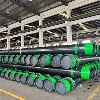
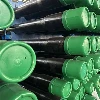
What a 9-5/8 in. (244.5 mm) Casing Pipe Does in the Well
The string is run after the surface casing and before the production casing. It holds back the formations the surface string did not cover, seals off lost-circulation and sloughing intervals, and gives the production string and the wellhead a load path. The size is a compromise that has held for decades: 244.5 mm is large enough to pass a 7 in. production string and the tools that follow it, and small enough to sit inside a 13-3/8 in. surface string with room for cement. On a 12-1/4 in. hole it leaves an annular clearance that still allows good displacement, which is why the size appears in so many programs even where the design loads would allow something smaller.
Two product specification levels apply to this size. PSL-1 is the standard level: chemistry, tensile and dimensional requirements, hydrostatic test on every joint. PSL-2 adds non-destructive examination of the body and ends, mandatory impact testing and tighter control of chemistry and dimensions, and it is the level written into most operator specifications for this string. PSL-3 is reserved for the highest grades and is rarely applied to a carbon steel intermediate string. The pipe is normally seamless in 244.5 mm; ERW is available in J55 and K55 where the well does not call for a seamless body.
ID of 9-5/8 in. (244.5 mm) casing pipe: The Number Weight Actually Fixes
Inside diameter is not a separate line on the specification. It is what remains after the wall is rolled, calculated as OD minus twice the wall thickness: on a 244.48 mm (9.625 in) body the bore runs from 226.6 mm at 36.0 lb/ft down to 216.8 mm at 53.5 lb/ft. That 9.8 mm spread is the whole argument for choosing a weight carefully, because it decides which packer, bridge plug, liner hanger and logging tool will pass through the string once it is cemented.
Table 1 - Inside diameter and drift of 9-5/8 in. (244.5 mm) casing, by nominal weight
| lb/ft | kg/m | Wall (in) | Wall (mm) | ID (in) | ID (mm) | Drift (in) | Drift (mm) | D/t |
|---|---|---|---|---|---|---|---|---|
| 36.0 | 53.57 | 0.352 | 8.94 | 8.921 | 226.6 | 8.765 | 222.6 | 27.3 |
| 40.0 | 59.53 | 0.395 | 10.03 | 8.835 | 224.4 | 8.679 | 220.5 | 24.4 |
| 43.5 | 64.74 | 0.435 | 11.05 | 8.755 | 222.4 | 8.599 | 218.4 | 22.1 |
| 47.0 | 69.95 | 0.472 | 11.99 | 8.681 | 220.5 | 8.525 | 216.5 | 20.4 |
| 53.5 | 79.62 | 0.545 | 13.84 | 8.535 | 216.8 | 8.379 | 212.8 | 17.7 |
OD 244.48 mm (9.625 in) nominal. Drift is the API 5CT drifting mandrel diameter, which is the nominal ID less 0.156 in (4 mm). Wall, ID and drift are API 5CT Table C.18 values; D/t is calculated from nominal OD and nominal wall.
Reading the Inside Diameter Against the Tool String
Three numbers matter and they are not interchangeable. The nominal ID is arithmetic from the nominal wall. The guaranteed bore is smaller, because wall thickness may run 12.5 % under nominal. The drift is smaller again and is the only one that carries a physical test: the casing drift diameter is measured with a mandrel, not calculated, and a cylindrical mandrel of that diameter must pass the full length of every joint. A completion tool sized to the nominal ID will one day stop in a joint that passed inspection, and the rig will spend a day finding out. Size the tool to the drift, and if the margin is under about 3 mm, check with the tool vendor before the string is ordered.
9-5/8 in casing weight: 36, 40, 43.5, 47 and 53.5 lb/ft
Nominal weight is a calculated figure, not a weighed one: it is the mass of one foot of pipe at nominal OD and nominal wall, with the coupling and the thread excluded. All five weights share the same outside diameter, so going up in weight means a thicker wall and a smaller bore, never a different hole size. Two other weights sit outside the normal range and are worth knowing about. The 32.3 lb/ft (0.312 in) combination still appears in API 5CT but is rarely rolled, and the heavy walls from 58.4 to 75.6 lb/ft exist for special-drift work where the bore is sacrificed to collapse resistance.
Table 2 - Engineering data per weight, 244.5 mm OD
| lb/ft | kg/m | ID (mm) | Capacity (bbl/ft) | Body yield at 80 ksi (kip) | What the extra wall buys |
|---|---|---|---|---|---|
| 36.0 | 53.57 | 226.6 | 0.0773 | 820 | Maximum bore, lightest handling load |
| 40.0 | 59.53 | 224.4 | 0.0758 | 916 | The balanced string: bore, collapse and cost |
| 43.5 | 64.74 | 222.4 | 0.0745 | 1,005 | Collapse margin with the same OD |
| 47.0 | 69.95 | 220.5 | 0.0732 | 1,086 | Deep intermediate, bending and tension |
| 53.5 | 79.62 | 216.8 | 0.0708 | 1,244 | Maximum collapse and burst, smallest bore |
Capacity = ID squared / 1029.4 (bbl/ft). Body yield = steel area x 80 ksi yield strength, calculated from nominal dimensions for comparison only; the value for the grade ordered scales with its specified minimum yield strength.
Casing weight tolerance runs with the nominal figure on the order: a single joint may weigh 3.5 % under or 6.5 % over, so a 40 lb/ft joint can legally arrive between 38.6 and 42.6 lb/ft. That tolerance exists because wall thickness itself is allowed to run 12.5 % under nominal. Neither allowance is a license to under-run the design, but both explain why a casing tally weighed on site rarely matches the calculated figure to the kilogram.
9-5/8 in., 40 lb/ft casing pipe: Why It Is the Default Wall
The 9-5/8 in., 40 lb/ft casing pipe is the combination most intermediate strings are built around: 10.03 mm wall, 224.4 mm bore, 220.5 mm drift and 59.53 kg/m. The reason is clearance. An 8-1/2 in. (215.9 mm) tool passes the 40 lb/ft drift with 4.6 mm to spare, so a program that sets 244.5 mm casing and then drills an 8-1/2 in. hole below keeps its options open. Go to 53.5 lb/ft for more collapse resistance and the drift falls to 212.8 mm, and that same 8-1/2 in. tool no longer fits; even 47 lb/ft clears it by only 0.6 mm. Designers who need the heavier wall therefore re-plan the hole and the completion at the same time, and that is a decision that belongs before the inquiry, not after the quotation.
What the Casing Data Sheet Has to Carry Before a String Is Ordered
A buyer forwards the data sheet to a drilling engineer, a QA inspector and a freight forwarder, and each of them needs a different line from it. That is why casing pipe specifications for this size are best laid out as a comparison document rather than a catalog page: every value that can change the price or the running time has to be printed, so two offers can be read side by side. On this size the list is short and specific.
Outside diameter with its tolerance band, and the size designation exactly as the mill marks it
Nominal weight, nominal wall and the minimum wall that will be accepted
Calculated ID and the drift diameter, both stated, never the ID alone
Grade and type, for example N80-1 or N80Q, because the two are not interchangeable
PSL level and any supplementary requirement such as impact testing or a hardness ceiling
End finish and coupling: STC, LTC or BTC, with coupling OD and make-up length
Length range R1, R2 or R3, and the allowed spread inside it
Hydrostatic test pressure, drift test, NDT coverage and the certificate standard
Table 3 - API casing connections available on 244.5 mm pipe
| End finish | Thread | Coupling OD (mm / in) | Coupling length (mm) | Tension capacity | Specify for |
|---|---|---|---|---|---|
| STC | Short round, 8 threads/in | 269.9 / 10.625 | 196.9 | Lowest of the three | Shallow strings, low hanging weight |
| LTC | Long round, 8 threads/in | 269.9 / 10.625 | 266.7 | Higher than STC | Standard intermediate strings |
| BTC | Buttress, 3° load flank | 269.9 / 10.625 | 269.9 | Close to pipe body strength | Deep or high-tension strings, gas wells |
Coupling dimensions to API 5B. Special-clearance buttress couplings reduce the outside diameter for tight annulus work; confirm the figure on the data sheet rather than assume it.
Two offers can both read "9-5/8 in. 40 lb/ft N80" and still describe different pipe: N80-1 against N80Q, PSL-1 against PSL-2, STC against BTC, R2 against R3, standard drift against special drift. Five lines, each of which moves the price and the running time. None of them can be recovered from a unit price, which is why the sheet, not the quotation, is the document to compare.
One file with the ID and drift table, the coupling dimensions, the tolerances and the grade limits for this size, so it can be attached to a bid or printed as a receiving checklist. Send the weight and grade you are working to and the sheet comes back filled in for that string.
Get the 9-5/8 in casing specifications PDF
API 5CT Casing Grades for 244.5 mm Pipe
Grade fixes yield strength, and in sour service it also fixes hardness and chemistry. The practical split is not strength at all but whether the string will see hydrogen sulfide, because no amount of yield strength compensates for a grade that is not hardness controlled.
Table 4 - Mechanical requirements by grade
| Grade | Yield min (MPa) | Yield max (MPa) | Tensile min (MPa) | Hardness max | Sour service |
|---|---|---|---|---|---|
| H40 | 276 | 552 | 414 | Not specified | No |
| J55 | 379 | 552 | 517 | Not specified | No |
| K55 | 379 | 552 | 655 | Not specified | No |
| N80-1 / N80Q | 552 | 758 | 689 | Not specified | No |
| L80-1 | 552 | 655 | 655 | 23 HRC | Yes |
| C90-1 | 621 | 724 | 689 | 25.4 HRC | Yes |
| T95-1 | 655 | 758 | 724 | 25.4 HRC | Yes |
| P110 | 758 | 965 | 862 | Not specified | No |
| Q125-1 | 862 | 1,034 | 931 | Not specified | No |
API 5CT values in SI units. Sour service means the grade is hardness controlled and can be qualified to NACE MR0175 / ISO 15156 within its stated limits; it is not an automatic approval for every H2S partial pressure.
Sweet Service: N80 casing, N80Q or P110
N80 casing is the workhorse of the 244.5 mm string. Type 1 is normalized and Type Q is quenched and tempered: same yield band, same minimum tensile, different toughness and a different price. Where the well is deep enough that burst or collapse governs, P110 carries roughly a third more yield in the same wall, at the cost of toughness and a bigger price step. Both grades are open in their chemistry apart from phosphorus and sulfur, so the mill has room to make them by more than one route, and the type suffix on the order is what closes that door. Below N80 there is still a place for the cheaper grades: K55 covers light intermediate strings where burst and collapse are not the governing case, and H40 appears only on the shallowest strings. Above P110, Q125 adds a further step of yield for HPHT work and is usually ordered in the heavier walls of this size.
Sour Service: L80, C90 and T95
Once H2S is present at a partial pressure that engages NACE MR0175 / ISO 15156, the choice moves to a hardness-controlled grade: L80-1 at 23 HRC, or C90 and T95 at 25.4 HRC where more strength is needed. L80-1 is a carbon-manganese grade with a 0.45 % silicon ceiling; C90-1 carries 0.25-0.85 % molybdenum, and T95-1 adds 0.40-1.50 % chromium to that. N80 and P110 are not acceptable in that service whatever their strength, and a supplier who offers them for a sour string has either misread the inquiry or is quoting something the mill will not certify.
Table 5 - Chemical requirements, maximum unless a range is given (%)
| Grade | C | Mn | Mo | Cr | Ni | P | S |
|---|---|---|---|---|---|---|---|
| H40 / J55 / K55 | NL | NL | NL | NL | NL | 0.030 | 0.030 |
| N80-1 / N80Q | NL | NL | NL | NL | NL | 0.030 | 0.030 |
| L80-1 | 0.43 | 1.90 | NL | NL | 0.25 | 0.030 | 0.030 |
| C90-1 | 0.35 | 1.20 | 0.25-0.85 | NL | 0.99 | 0.020 | 0.010 |
| T95-1 | 0.35 | 1.20 | 0.25-0.85 | 0.40-1.50 | 0.99 | 0.020 | 0.010 |
| P110 | NL | NL | NL | NL | NL | 0.030 * | 0.030 * |
| Q125-1 | 0.35 | 1.35 | 0.85 | 1.50 | 0.99 | 0.020 | 0.010 |
NL = no limit. * Electric-welded P110 is held to 0.020 % P and 0.010 % S. L80-1 also carries 0.45 % maximum silicon and 0.35 % maximum copper; C and Mo footnotes for thin-wall and oil-quenched material are in API 5CT Table E.5 and apply as written there.
Wall Thickness and Weight Tolerances on a 244.5 mm Joint
Tolerance is where a quotation that looks cheap meets a string that does not fit. The three that matter on this size are diameter, wall and length, and each hides a different problem: diameter affects the drift and the coupling fit, wall affects collapse, length affects how the string stacks up against the plan.
Table 6 - API 5CT tolerances and length ranges for 244.5 mm casing
| Item | Tolerance or range | What it means in practice |
|---|---|---|
| Outside diameter | -0.5 % / +1.0 % (D ≥ 114.3 mm) | 2.4 mm of latitude on a 244.5 mm body; drift absorbs the ovality |
| Wall thickness | 0 / -12.5 % | A 0.395 in. wall may arrive at 0.346 in. (8.78 mm) |
| Weight, single joint | -3.5 % / +6.5 % | 40 lb/ft may weigh 38.6 to 42.6 lb/ft |
| Weight, carload lot | -1.75 % | Applied to lots of 18,144 kg and above |
| Length, R1 | 4.88-7.62 m (16-25 ft) | Short joints, more connections per string |
| Length, R2 | 7.62-10.36 m (25-34 ft) | The common range for this size |
| Length, R3 | 10.36-14.63 m (34-48 ft) | Fewer connections, needs a longer rig floor |
| Straightness | 0.2 % of total length | 1.5 m from each end held to 3.18 mm |
| Coupling wall | 0 / -12.5 % | Undersized couplings are a documented reject |
The wall tolerance is the one to design against when collapse governs. A published collapse rating is calculated on nominal wall, so a joint at the minus limit is carrying a rating it cannot deliver, and that is why the higher collapse grades and the heavy walls exist. If the design load sits close to the collapse figure, specify the minimum wall as well as the weight, and ask for the wall to be reported on the inspection documents. Where the string is to be run through a tight annulus or a depleted zone, ask for special drift at the same time, because the two requirements pull in opposite directions and both have to be on the order before the mill cuts the wall.
Specifying and Verifying a 9-5/8 in. Casing Order
An inquiry that carries these eight items comes back as a firm offer instead of a range, and the offer can be compared with the next one without a second round of questions:
Outside diameter and the weight, written together, for example 244.5 mm x 40 lb/ft
Grade and type, with N80-1 or N80Q named rather than left open
PSL level and any supplementary requirement, including impact test temperature
End finish and coupling type, with special clearance stated if the annulus needs it
Length range and the acceptable spread within it
Drift requirement, standard or special, and the tool diameter if it is special
Certificate standard, EN 10204 3.1 or 3.2, and whether third-party inspection applies
Quantity in joints or in meters, with the total tonnage expected from the nominal weight
On receipt, check the joint rather than the paperwork: pass the drift mandrel, measure the wall at four points on both ends, check coupling outside diameter and make-up length against API 5B, check straightness over the full length, and match the stencil and heat number to the mill certificate. A joint that fails any of those is a rejection on measurement, not a matter for negotiation, and the certificate is the document that decides whether the heat it came from can be replaced quickly. Send the casing program and the eight items above through the contact page and we will return a data sheet with the drift, the coupling and the test plan attached, so the offer can be checked line by line before it is placed.
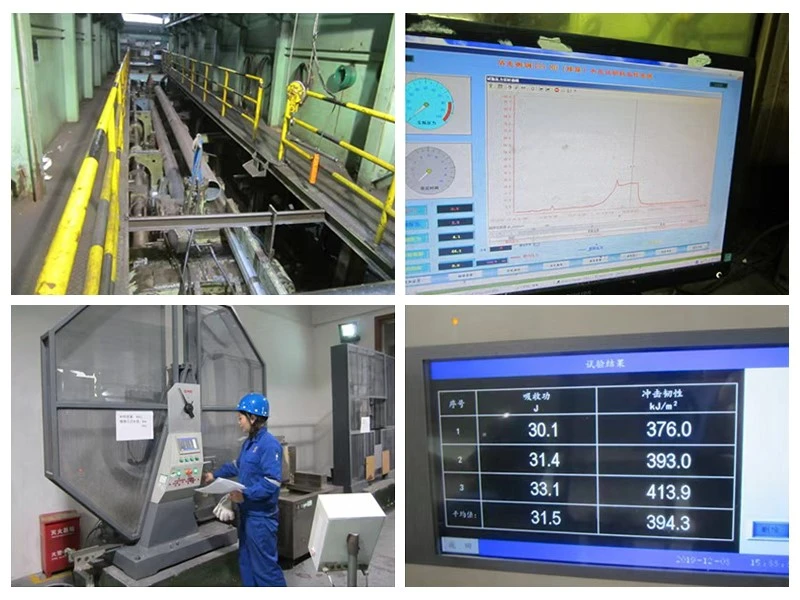
Casing pipe test and inspection
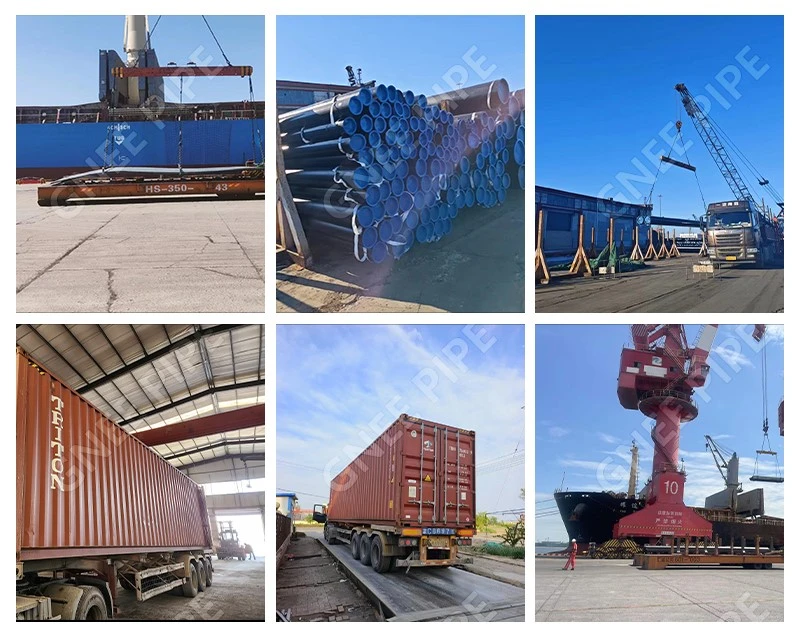
packaging and shipping
Ready to price a string? Send the outside diameter, weight, grade, end finish and length range with the quantity in joints or in meters, and the offer comes back against those eight lines instead of a range. Request a quotation.
FAQ
Is 9-5/8 in. the same as 244.5 mm on a casing purchase order?
Yes for ordering purposes, with one habit worth keeping. API 5CT designates the size 244.48 mm and the inch figure is 9.625; 244.5 mm is the rounded value used in catalogs and design documents. The 0.02 mm difference sits well inside the outside diameter tolerance, so either wording describes the same pipe. What must not be left open is the weight, because the weight code is what fixes the wall, the inside diameter and the drift.
Can a 9-5/8 in. casing be ordered to a guaranteed minimum wall instead of a nominal weight?
It can, and on a collapse-controlled string it should be. Weight is ordered by nominal value with a 12.5 % wall under-tolerance, so a nominal 0.395 in. wall can arrive at 0.346 in. State the minimum acceptable wall next to the weight, require the wall to be reported on the inspection documents, and expect the mill to price it as a controlled item rather than as stock pipe.
Which 9-5/8 in. weight still passes the same drift mandrel as the lightest wall?
None of the heavier ones, and that is the point. Drift falls as the wall grows: 222.6 mm at 36.0 lb/ft, 220.5 mm at 40.0, 218.4 mm at 43.5, 216.5 mm at 47.0 and 212.8 mm at 53.5. If a tool of fixed outside diameter has to pass, the heaviest weight that still clears it is the answer. An 8-1/2 in. (215.9 mm) tool clears 47.0 lb/ft by 0.6 mm and does not clear 53.5 lb/ft at all.
Why is the casing data sheet sent as a file instead of a page?
Because it is used by three people who never open the same system. The drilling engineer marks the drift and the wall, QA writes the test pressures and the certificate standard into the inspection plan, and the forwarder needs the coupling outside diameter and the length range for the lift plan. A fixed file keeps those lines where they were when it left the office, prints as a receiving checklist at the rack, and attaches to a technical bid without being retyped. The 9-5/8 in casing specifications PDF is therefore issued as a document, not as a page that can change under the reader.
What rejection criteria apply when a 244.5 mm joint arrives on site?
Five measurements decide it: the drift mandrel must pass the full length, wall must not fall below 87.5 % of nominal, single-joint weight must sit within minus 3.5 % and plus 6.5 %, coupling outside diameter and make-up length must match API 5B, and straightness must stay within 0.2 % of length. Thread damage and a stencil that does not match the heat number on the certificate are rejections as well, and both are easier to catch on the rack than after running.
How does PSL-2 change a 9-5/8 in. casing order compared with PSL-1?
PSL-2 adds non-destructive examination of the body and the ends, mandatory impact testing and tighter control of chemistry and dimensions, and the mill has to hold those records for the heat rather than for the lot. On a 244.5 mm intermediate string it is the level most operator specifications call for, and it is where the price difference between two apparently identical offers usually comes from.