The Five Types of Casings in a Well
The cleanest way to answer what the types of casings are is to follow them from the surface down. Each string is a distinct product with its own function, diameter range, setting depth and typical grade. Not every well uses every type, but the sequence below is the standard, with the outermost string set first and each later string passing through the one before it.
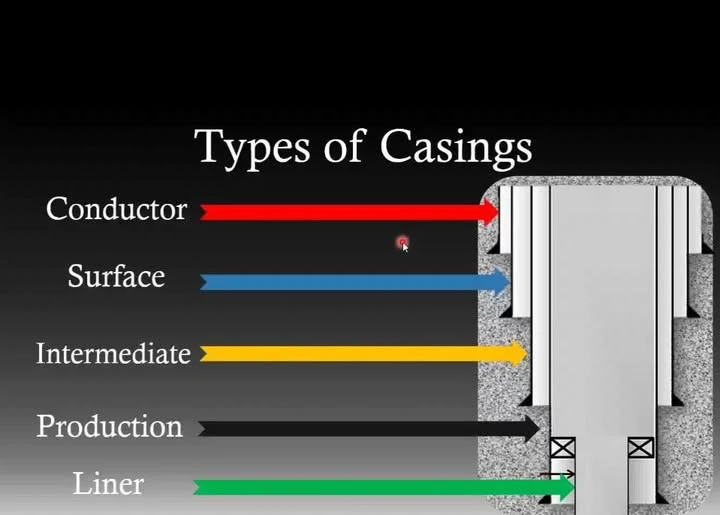
| String | Position in well | Primary job | Typical grade family |
|---|---|---|---|
| Conductor casing | Outermost, shallowest | Stabilize loose topsoil; support wellhead | H40 / J55 or line pipe |
| Surface casing | Inside conductor | Isolate freshwater; anchor BOP | J55 / K55 |
| Intermediate casing | Below surface string | Seal off problem formations | N80 / L80 |
| Production casing | Innermost full string | Reach reservoir; long-term flow path | N80 / P110 / L80 |
| Liner casing | Hung, not to surface | Replace part of a full string | Same grades as parent string |
The exact string count and sizes follow the casing programme and local regulation. Grades shown are the common families, not a design recommendation.
How Casing Strings Nest From Top to Reservoir
Casing strings step down in diameter because each must fit through the string above it and leave an annulus wide enough for a competent cement sheath. This nesting is the reason a single well orders several different sizes rather than one. The table shows a widely used size progression for a land well; offshore and deep wells may add strings and start larger.
| Order | String | Typical OD (in) | Typical OD (mm) | Set at |
|---|---|---|---|---|
| 1 | Conductor | 20 | 508.0 | Shallow top hole |
| 2 | Surface | 13-3/8 | 339.7 | Below freshwater zone |
| 3 | Intermediate | 9-5/8 | 244.5 | Past problem formations |
| 4 | Production | 7 or 5-1/2 | 177.8 / 139.7 | Across the reservoir |
Sizes are representative of common practice. The governing casing programme sets the actual outside diameters, weights and setting depths for a given well.
Conductor Casing: The Outermost String
Conductor casing is the first and largest pipe set in the well, usually driven or drilled and cemented at shallow depth. It is not designed as a pressure-containing string. Its work is to stop loose near-surface soil from caving in, isolate shallow water sands, carry the wellhead and the initial drilling load, and provide a return path for drilling fluid. Because the duty is structural, much conductor pipe is supplied as large-diameter line pipe or a low-grade OCTG product; API 5CT H40 casing is a common low-grade choice where OCTG material is required.
Typical conductor diameters run from about 16 to 36 inches, with 20 and 24 inch common on land and larger sizes offshore. Wall thickness is chosen for driving or cementing loads rather than internal pressure. Confirm with the well designer whether the order calls for a line-pipe material or an API 5CT grade, since the two come with different certificates and connections.
Surface Casing: The Freshwater and Wellhead Barrier
Surface casing is run inside the conductor and cemented from its shoe back to surface. Its primary regulatory purpose is to protect underground sources of drinking water by sealing the shallow interval below the deepest aquifer. It also provides the structural landing point for the blowout preventer stack. Common outside diameters are 13-3/8, 10-3/4 and 9-5/8 inches, normally in J55 or K55 with a long-thread connection.
Because this string is a permanent environmental barrier, surface casing is normally OCTG to API 5CT / ISO 11960. Reference products include API 5CT J55 casing and API 5CT K55 well drilling casing. Setting depth follows the deepest protected water zone and local rules; the cement job and its test are accepted before the next hole section is drilled.
Intermediate Casing: Isolating Problem Formations
Intermediate casing, also called technical casing, is set between the surface and production strings when the open hole cannot be drilled safely to total depth in one section. It seals off intervals that would otherwise cause lost circulation, abnormal pressure, unstable shale or salt problems, and it lets the operator continue drilling with a controlled mud weight. A well may require more than one intermediate string.
These strings are commonly 9-5/8 or 7 inches in diameter and use grades such as N80 or L80, with weights chosen against collapse and burst loads. A API 5CT N80 casing is typical where loads are moderate; a API 5CT L80 casing is selected where sour service applies, subject to NACE MR0175 / ISO 15156. Connection choice moves from LTC to BTC or a premium thread as tension and gas-tightness demands rise.
Production Casing: The Final Cemented String
Production casing is the last full-length string set across the reservoir. It provides the permanent path for oil or gas to reach the surface, isolates the producing zone from other formations, and carries the completion equipment. Common diameters are 7, 5-1/2 and 4-1/2 inches, and the string must withstand collapse on drawdown, burst during stimulation and the tensile load of its own weight.
Because it is exposed to the highest combined loads and is effectively irreplaceable once cemented, production casing often uses P110 or Q125, with an L80 grade where H2S is present. Reference products include API 5CT Q125 casing. Premium connections are common in gas and horizontal completions where a metal-to-metal seal is required. Grade, weight and connection should be confirmed against the well design rather than substituted on price.
Liner Casing and Tieback Options
Liner casing is a partial string hung from a liner hanger inside the previous casing rather than run back to surface. It performs the function of an intermediate or production string over the interval where it is set, while saving steel and reducing the hook load on the rig. Liners are common in deep wells and in completions where running a full string to surface is uneconomic or impractical.
A liner is specified by its outside diameter, grade, connection, length and the lap length over which it overlaps the parent casing, together with the hanger and any tieback arrangement. It is a different purchase line from a full string and must be matched to the drift of the casing it hangs inside. Because it saves material, a liner can materially reduce the casing cost of a deep well without changing the barrier it provides over the producing interval.
Oil Well Casing Sizes and the Standard Size Series
Oil well casing sizes are described by outside diameter and nominal weight per foot, not by bore. Standard casing sizes run from 4-1/2 to 20 inches outside diameter, with each diameter offered in several wall thicknesses. A heavier wall raises collapse and burst resistance but reduces the inside diameter and the drift available to tools and the next string. The buyer therefore states both diameter and weight on every line.
| OD (in) | OD (mm) | Commonly associated with | Note |
|---|---|---|---|
| 20 | 508.0 | Conductor / large surface | Outermost strings |
| 13-3/8 | 339.7 | Surface casing | Freshwater isolation |
| 9-5/8 | 244.5 | Intermediate or surface | Workhorse intermediate size |
| 7 | 177.8 | Production or intermediate | Higher-rate completions |
| 5-1/2 | 139.7 | Production casing | Common final string |
| 4-1/2 | 114.3 | Production casing | Smaller completion |
Diameters are nominal outside diameters. Confirm wall thickness, weight, grade and drift against the current API 5CT / ISO 11960 tables for the delivered edition.
API 5CT Casing Grades and Casing Connections
Under API 5CT, casing grades are defined by minimum yield strength, chemistry and heat treatment. Casing grades span H40 through Q125; higher numbers carry more load but are generally less tolerant of sour service, so selection is a balance between strength and resistance to environmental cracking. Casing connections are separately defined in API 5B.
| Grade | Min. yield (ksi) | Typical use | Sour service |
|---|---|---|---|
| H40 | 40 | Conductor, shallow wells | No |
| J55 | 55 | Surface and shallow strings | No |
| K55 | 55 | Surface strings with impact requirement | No |
| N80 | 80 | Intermediate and production | No |
| L80 | 80 | Production, corrosive wells | Yes (Type 1) |
| C90 / T95 | 90 / 95 | Sour-service strings | Yes |
| P110 | 110 | Deep, high-pressure wells | No |
| Q125 | 125 | Ultra-deep, high load | No |
Yield values are minimums in thousands of psi. Sour-service suitability follows NACE MR0175 / ISO 15156 and the specific supplementary requirement on the order.
| Connection | API designation | Characteristic | Typical use |
|---|---|---|---|
| Short round | STC | Short threaded, coupled; economical | Shallow, low-load strings |
| Long round | LTC | Longer thread, higher joint strength | Surface and intermediate |
| Buttress | BTC | Buttress profile; high tension | Heavier wall and deeper strings |
| Premium | Proprietary | Metal-to-metal seal; gas-tight | Gas, high torque, horizontal wells |
API threads rely on thread compound for the seal. Where a gas-tight seal is required, specify a premium connection rather than assuming an API thread will hold gas.
Buyer Checklist for a Casing Programme
Because casing is permanent once cemented, a specification error is costly to correct. A comparable quotation needs the full specification for every string, not just its diameter. The checklist below is worth repeating at enquiry, purchase order and goods-in.
| Field | What to specify | Typical error if missed |
|---|---|---|
| Size | Outside diameter and nominal weight or wall | Right OD, wrong wall and drift |
| Grade | API 5CT grade and heat-treatment condition | Lower grade substituted on price |
| Connection | STC / LTC / BTC or named premium thread | Thread incompatible with mating string |
| Length | API range R1 / R2 / R3 and total quantity | Joint count and tally mismatch |
| Condition | Setting depth and cement scope | String not suited to the interval |
| Extras | Sour-service limit, impact test, drift, MTC scope | Certificate not matching the well |
Require a mill test certificate traceable to the delivered heat, with chemistry, mechanical properties and heat treatment, plus evidence of API 5CT / ISO 11960 and API 5B conformity and thread gauging. For sour or low-temperature duty, add the relevant supplementary requirement to the order so it appears in both the pipe and the documentation.
oil and gas well casing for sale
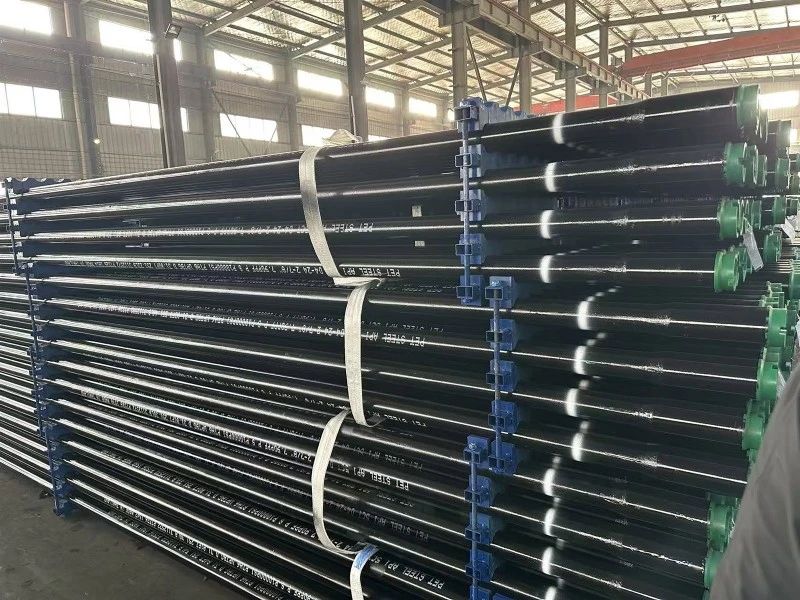
If you have the casing programme - the diameter, weight, grade, connection, length range and quantity for each string - send it with the setting conditions and the required certificate scope. A quotation can then be built against the exact string rather than a generic catalogue price, and the grade and documentation can be confirmed before the order is placed.
View casing products
FAQ
How many casing strings does a typical oil or gas well have?
Most wells use three to five concentric strings, but the count depends on depth, formations and local rules. A simple shallow well may need only a conductor, a surface string and a production string. A deep or complex well adds one or more intermediate strings to isolate abnormal pressure or unstable zones, and may finish with a liner rather than a full production string. The casing programme, not a standard number, dictates how many are run.
Why does each casing string have a smaller outside diameter?
Every string must pass through the inside diameter of the string already set above it, with enough annular clearance for cement to flow around the pipe. A 20 inch conductor therefore carries a 13-3/8 inch surface string, which carries a 9-5/8 inch intermediate string, which in turn carries a 7 or 5-1/2 inch production string. Trying to run a larger string through a smaller one is the most basic geometrical error in a casing design.
Which casing string protects groundwater?
The surface casing is the designated freshwater barrier. It is set below the deepest protected aquifer and cemented from the shoe back to surface so that drilling fluids, hydrocarbons or completion fluids cannot migrate up behind the pipe into the water zone. Regulators commonly set its minimum depth and require a cement bond or pressure test before drilling continues.
What is the difference between intermediate casing and production casing?
Intermediate casing is a temporary drilling-enabler: it isolates problematic intervals such as lost-circulation zones, abnormal pressure or reactive shale so the well can be drilled deeper. Production casing is the final cemented string set across the reservoir; it provides the long-term flow path and the pressure boundary for completion and production. Production casing therefore carries higher integrity and often a higher grade or premium connection.
Is a liner counted as a full casing string?
A liner is a partial string. It is hung from a liner hanger inside the previous casing and does not extend back to surface, which saves steel and reduces hook load. It can replace an intermediate or a production string. Because it is not tied back to the wellhead, a liner is specified with its hanger, tieback options and lap length in mind, and it is a different line item from a full string.
What steel grades are available for oil well casing?
API 5CT grades range from H40 and J55 through K55, N80, L80, C90, T95, P110 and Q125, where the number broadly indicates minimum yield strength in thousands of psi. J55 and K55 suit shallow, low-load strings; N80 is common for intermediate and production duty; L80, C90 and T95 are used in sour service subject to NACE MR0175 / ISO 15156; P110 and Q125 serve deep, high-pressure wells. Grade selection follows the load and environment, not price alone.
What connections are used to join casing joints?
Casing joints are joined by API round threads and buttress threads defined in API 5B: STC (short thread and coupled), LTC (long thread and coupled) and BTC (buttress thread and coupled). LTC gives better joint strength, BTC is common on heavier wall and higher tension strings, and both rely on thread compound for the seal. Where gas-tight performance or high torque is required, a premium metal-to-metal connection is specified instead.
What information does a buyer need for a casing enquiry?
For each string, state the outside diameter, nominal weight per foot or wall thickness, API 5CT grade, connection type, length range and quantity. Add the setting depth and any supplementary requirements such as sour-service limits, impact testing or drift diameter. Because casing is permanent once cemented, quotes should be compared on the full specification - OD, weight, grade, connection and range together - rather than on diameter alone.