




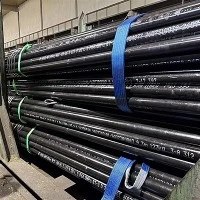
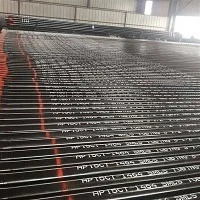


API 5CT Surface Casing
Common sizes: 13-3/8 - 20 in
Common grades: H40 / J55 / K55 / N80
Body styles: Seamless / ERW
Connections: STC / LTC / BTC
Length ranges: R1 / R2 / R3
API 5CT surface casing is the large-diameter steel tubular that is run first in a well's casing programme and cemented back to surface. Supplied to API Spec 5CT / ISO 11960, it is a finished product - a plain-end or threaded pipe made up with couplings - manufactured either seamless or as ERW casing and ordered in grades such as H40, J55, K55 and N80. Its job is to isolate shallow freshwater and gas and to carry the wellhead, and buyers of API 5CT well surface casing specify it by outside diameter, nominal weight, grade, connection, length range and product specification level.
Product Specification
| Item | Specification |
|---|---|
| Standard | API Spec 5CT / ISO 11960 (current edition as ordered) |
| Product | Surface casing, plain end or threaded with couplings |
| Outside diameter | Commonly 13-3/8, 16, 18-5/8 and 20 in; 9-5/8 and 10-3/4 in for slimmer wells |
| Nominal weight | Per API 5CT size-and-mass list, e.g. 13-3/8 in at 48-72 lb/ft |
| Manufacturing route | Seamless (SMLS) or electric-resistance welded (ERW) |
| Grades | H40, J55, K55, N80; L80 where sour service is specified |
| Connections | STC, LTC, BTC to API Spec 5B; premium connections where designed |
| Length range | R1 / R2 / R3 |
| Specification level | PSL1 or PSL2 as selected in the well design |
| Testing | Hydrostatic test, drift test, NDT where required, thread gauging |
| Documentation | Mill test certificate EN 10204 3.1 (3.2 if agreed), API monogram evidence |
Steel Grades and Specification Levels
Surface casing is normally supplied in the lower-strength general-purpose grades because the shallow section carries modest loads. H40 is the light-duty end, while J55 and K55 are the standard choices, K55 offering higher tensile strength at the same minimum yield. N80 is selected for higher collapse or burst demand, and L80 when a controlled-hardness grade is needed for sour service, in which case conformity to NACE MR0175 / ISO 15156 must be stated. H40 casing covers the lightest duty.
The product specification level is a separate order item from the grade. PSL1 covers the basic requirements; PSL2 adds tighter dimensional control, additional testing and more extensive traceability. Buyers of API 5CT well surface casing confirm the level from the approved well programme rather than assuming it, because it changes both the inspection scope and the certificate content.
Chemical Composition
API 5CT fixes mechanical properties and heat-treatment condition for the general-purpose grades rather than a single compulsory chemistry, so the certificate for the delivered heat is the controlling document. The typical ranges below are guidance for grade selection and are not a substitute for the mill test certificate.
| Grade | C | Mn | P max | S max | Si | Others |
|---|---|---|---|---|---|---|
| H40 / J55 / K55 | 0.30-0.39 | 1.20-1.50 | 0.030 | 0.030 | 0.20-0.35 | Cu/Ni/Cr residual |
| N80 | 0.34-0.38 | 1.45-1.70 | 0.030 | 0.030 | 0.20-0.35 | Cr, Ni, Cu each <= 0.15 |
| L80 Type 1 | 0.34-0.44 | 0.40-0.70 | 0.020 | 0.030 | 0.20-0.35 | Cr 0.80-1.10 |
Typical mill chemistry for guidance only. API Spec 5CT / ISO 11960 and the agreed specification level govern; sour-service grades carry additional hardness and chemistry restrictions.
Mechanical Properties
Yield and tensile strength are the primary selection numbers, but collapse resistance also depends on the outside-diameter-to-wall ratio, so weight and wall must be considered together with the grade. The values below are the API 5CT minimums for the listed grades.
| Grade | Yield min | Yield max | Tensile min | Typical surface-casing duty |
|---|---|---|---|---|
| H40 | 276 MPa / 40 ksi | 552 MPa / 80 ksi | 414 MPa / 60 ksi | Very shallow, low load |
| J55 | 379 MPa / 55 ksi | 552 MPa / 80 ksi | 517 MPa / 75 ksi | Standard surface string |
| K55 | 379 MPa / 55 ksi | 552 MPa / 80 ksi | 655 MPa / 95 ksi | Higher-tensile surface string |
| N80 | 552 MPa / 80 ksi | 758 MPa / 110 ksi | 689 MPa / 100 ksi | Higher collapse or burst |
| L80 Type 1 | 552 MPa / 80 ksi | 655 MPa / 95 ksi | 655 MPa / 95 ksi | Hardness-controlled service |
Values are common API 5CT minimums for guidance. The applicable edition, grade and specification level control the exact limits delivered on a purchase order.
API 5CT Surface Casing Sizes and Weights
Surface-casing sizes are identified by an outside diameter and a nominal mass designation in lb/ft. The mass designation is a size-and-mass label, not a measured weight for every joint; it fixes the nominal wall and inside diameter used in design. The table gives widely ordered combinations - verify each one against the current API 5CT size list and the agreed connection.
| OD (in) | OD (mm) | Nominal weight (lb/ft) | Wall thickness (mm) | Approx. nominal ID (mm) |
|---|---|---|---|---|
| 13-3/8 | 339.72 | 48.00 | 8.38 | 322.96 |
| 13-3/8 | 339.72 | 54.50 | 9.65 | 320.42 |
| 13-3/8 | 339.72 | 61.00 | 10.92 | 317.88 |
| 13-3/8 | 339.72 | 68.00 | 12.19 | 315.34 |
| 16 | 406.40 | 65.00 | 9.53 | 387.34 |
| 16 | 406.40 | 75.00 | 11.13 | 384.14 |
| 18-5/8 | 473.08 | 87.50 | 11.05 | 450.98 |
| 20 | 508.00 | 94.00 | 11.13 | 485.74 |
| 20 | 508.00 | 106.50 | 12.70 | 482.60 |
Nominal ID = OD minus twice the nominal wall; drift diameter is a separate mandated value and is always smaller. Values are reference combinations only; the ordered size, mass, wall and drift basis must be confirmed against the standard and the purchase specification.
Dimensional Tolerances
Dimensional limits are set by API 5CT and the agreed specification level. The commonly applied bands below are given so that a buyer understands what a delivered joint may vary within; the applicable edition controls the exact figures.
| Item | Permitted deviation |
|---|---|
| Pipe body OD <= 101.6 mm | +/- 0.79 mm |
| Pipe body OD >= 114.3 mm | -0.5% D to +1.0% D |
| Coupling OD | +/- 1% D |
| Wall thickness | -12.5% |
| Weight, single length | +6.5% / -3.5% |
| Length | R1 / R2 / R3 range as ordered |
Values shown are common API 5CT tolerance bands for guidance. Confirm the exact limits for the edition, size and specification level on the purchase order.
Manufacturing and Connections
Surface casing is produced by either the seamless route - piercing and rolling a billet - or by electric-resistance welding of strip, depending on the size and grade ordered. ERW surface casing is widely used in shallow, non-critical sections where the design permits it, while seamless pipe is chosen where the specification, the customer or the service environment calls for it. Both routes are then straightened, inspected, threaded and fitted with couplings.
The connection is cut to API Spec 5B. Short round (STC) and long round (LTC) threads are the usual choices for surface strings; buttress (BTC) is specified where greater joint strength is needed. A premium or gas-tight connection is only used when the well design requires it, since it adds cost without useful benefit on a shallow low-pressure section. Thread type, coupling and protectors should all appear in the order.
Inspection, Testing and Documentation
Each joint is hydrostatically tested to the pressure defined by the standard, grade and size, and a drift mandrel confirms that the bore is clear. Threads are checked with gauges, and non-destructive inspection such as ultrasonic or electromagnetic examination is applied where the specification level or grade requires it. For sour-service grades such as C110, hardness verification is added.
The document package is part of the product, not an optional extra: a mill test certificate to EN 10204 3.1 (or 3.2 when agreed), evidence of API monogram authorisation for the applicable specification level, and dimension, drift and thread-gauging records. Every certificate should be traceable to the heat and size actually delivered, and third-party inspection can be arranged when the buyer requires it.
How to Specify and Order
A clear enquiry for API 5CT surface casing sizes states the outside diameter, nominal weight or wall, grade, connection, length range, specification level and quantity, together with the standard edition and any sour-service, impact or coating requirement. Specifying the weight rather than a rough wall avoids ambiguity, because weight and wall define the drift and collapse behaviour together.
Ask for the certificate scope and inspection plan with the quotation, and confirm that the proposed manufacturing route and connection are covered by the stated API monogram. A quotation that leaves the specification level or connection undefined cannot be compared fairly, because both change what is supplied.
Test and inspection


Packaging and Shipping

If you have the size, nominal weight, grade and connection for your shallow section, send them with the length range, specification level and quantity. A quotation can then be built against the exact API 5CT / ISO 11960 line - with certificate scope and drift confirmed - instead of a generic catalogue price, and the large-diameter sizes that protect your freshwater interval can be reserved before the string is needed.
Request a Surface Casing Quotation
Related Product
API 5CT J55 Petroleum Casing Pipe
API 5CT Grade N80 Type Q Casing Steel Pipes
FAQ
What size range can you supply for API 5CT surface casing?
Surface casing is commonly ordered in large diameters such as 13-3/8 in, 16 in, 18-5/8 in and 20 in, with 10-3/4 in and 9-5/8 in used in slimmer or shallower programmes. Available sizes are tied to the API 5CT size-and-mass list and the manufacturing route, so confirm the exact outside diameter and nominal weight combination against the current edition before placing an order.
Which nominal weights are available in 13-3/8 in surface casing?
For 13-3/8 in (339.72 mm) the usual nominal weights are 48, 54.5, 61, 68 and 72 lb/ft, with the common J55/K55 choices at 48, 54.5, 61 and 68 lb/ft. Each weight fixes the wall thickness and nominal inside diameter, so the mass designation must be stated in the enquiry rather than left as an approximate wall.
Do you offer seamless and ERW surface casing to PSL1 and PSL2?
Both seamless and electric-resistance-welded (ERW) surface casing can be supplied, subject to the size, grade and product specification level ordered. PSL1 and PSL2 set different levels of inspection, testing and dimensional control; the purchaser selects the level in the well design, and the mill certificate and order acknowledgement must state which one applies.
Which connections are available on surface casing - STC, LTC or BTC?
Surface casing is most often threaded with short round (STC) or long round (LTC) connections, with buttress (BTC) used where higher joint strength is required. Threads are cut and gauged to API Spec 5B. The connection type is ordered explicitly because it changes coupling dimensions and the threaded-and-coupled mass of each joint.
Are mill test certificates and API monogram provided with surface casing?
A delivery is normally accompanied by a mill test certificate to EN 10204 3.1, or 3.2 when agreed, showing chemistry, yield, tensile and elongation results for the delivered heat. Evidence of API monogram authorisation for the applicable specification level, together with dimension, drift and thread-gauging records, should be requested and matched to the heat and size actually supplied.
What length ranges can be ordered for surface casing?
API 5CT defines R1 (about 4.88-7.62 m), R2 (about 7.62-10.36 m) and R3 (about 10.36-14.63 m) length ranges. R2 and R3 are the usual choices for surface strings, but the range length is a purchase decision tied to handling and make-up, and it must be written into the order together with the grade and connection.
How are hydrostatic and drift testing documented for each order?
API 5CT calls for a hydrostatic test of the pipe body and a drift test to confirm bore clearance; additional non-destructive inspection applies where the specification level or grade requires it. Test records are issued against the order and should identify the heat, size and quantity covered, so that the certificate can be traced back to the delivered joints.
What details are needed to quote an API 5CT surface casing enquiry?
A comparable quotation states the outside diameter, nominal weight or wall thickness, grade, connection, length range, product specification level, quantity and destination, plus the required standard edition and any sour-service or impact requirement. Quotations that omit the specification level or the connection cannot be compared fairly, because both change what is actually manufactured and certified.
Hot Tags: api 5ct surface casing, China api 5ct surface casing manufacturers, suppliers, factory
You Might Also Like


Send Inquiry